
Insights
How to Build a Vehicle Safety Inspection Station: A Complete Equipment Guide
Planning a vehicle safety inspection station? Learn the equipment, lane specs, and compliance steps to build a certified facility, with a 3T-15T setup checklist.
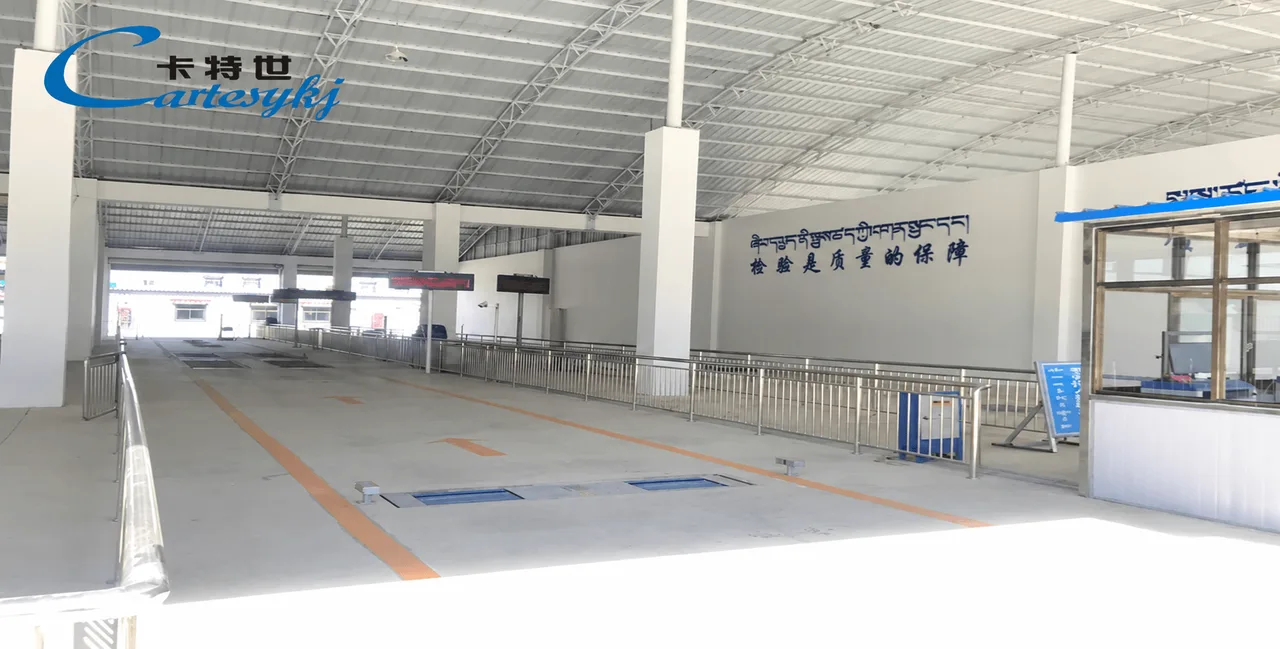
Planning a vehicle safety inspection station means making dozens of equipment decisions before you pour the first foundation. Which vehicles will you test? How many lanes do you need? What does your local authority require before it will license the site? This guide walks you through the lane types, core testers, site specifications, and certification steps you need to open a compliant facility. Whether you are upgrading a single lane or building a multi-bay center, you will finish with a practical, ordered checklist.
In this article: what a station really is · lane types by vehicle class · five core test systems · site and power requirements · software and licensing · business cases · FAQ
A vehicle safety inspection station is a system, not a single machine
A vehicle safety inspection station combines mechanical testers, sensors, and software into one controlled test lane. Its purpose is to verify roadworthiness against safety and environmental standards before a vehicle returns to public roads. A brake tester on its own cannot do that. Neither can an emissions analyzer. The value comes from how the units share data and enforce a fixed test sequence.
Understanding the purpose of vehicle safety inspections helps you design a station that meets real regulatory demand rather than just assembling hardware. Inspections catch brake imbalance, steering defects, chassis play, worn suspension, and excessive emissions. This is the practical importance of regular vehicle inspection: it removes unsafe vehicles from the road and creates a defensible record for regulators, insurers, and fleet managers who need to prove due diligence.
For operators, that purpose translates into three measurable goals:
- Throughput — move more vehicles through each lane per hour without lengthening the test cycle.
- Compliance — produce repeatable, tamper-proof results that authorities will accept without dispute.
- Accuracy — capture brake force, axle load, wheel alignment, and emissions data within stated tolerance.
A station that misses any one of these will struggle to justify its investment, regardless of how modern the individual machines look on the showroom floor. When you evaluate a supplier, judge the integrated lane, not the spec sheet of a single bench.
Choose your lane by vehicle class before you buy equipment
The single biggest mistake buyers make is purchasing equipment before defining which vehicles the lane must handle. Lane capacity drives everything downstream: frame strength, roller design, sensor range, pit dimensions, and even the floor loading of your building. Write down your expected vehicle mix first, then work backward to the hardware.
| Line type | Target vehicles | Core capabilities |
|---|---|---|
| 3T line | Sedans, SUVs, light vans | Fast-cycle brake, sideslip, and suspension checks |
| 15T line | Heavy trucks, coaches, multi-axle trailers | High-load braking, axle load verification, chassis stress detection |
| Emission line | Petrol, diesel, hybrid fleets | Multi-gas analysis, opacity, and particulate measurement |
According to Cartesy's vehicle inspection station configuration data (2026), a 3T line serves passenger cars and light commercial fleets, while a 15T line uses reinforced steel frames rated up to 15 tonnes without frame deflection. The two are not interchangeable. A 15T frame bought for a car-only workshop is wasted capital; a 3T bench placed on a truck route will fail both its sensors and its warranty.
Match the lane to your local vehicle mix first. A workshop serving mainly urban commuters rarely needs a 15T frame, but a facility next to a logistics corridor will lose business without one. Many operators solve this by combining a light-duty lane with one reinforced lane, then routing vehicles by weight at check-in. That hybrid layout keeps throughput high while avoiding the cost of over-building every bay.
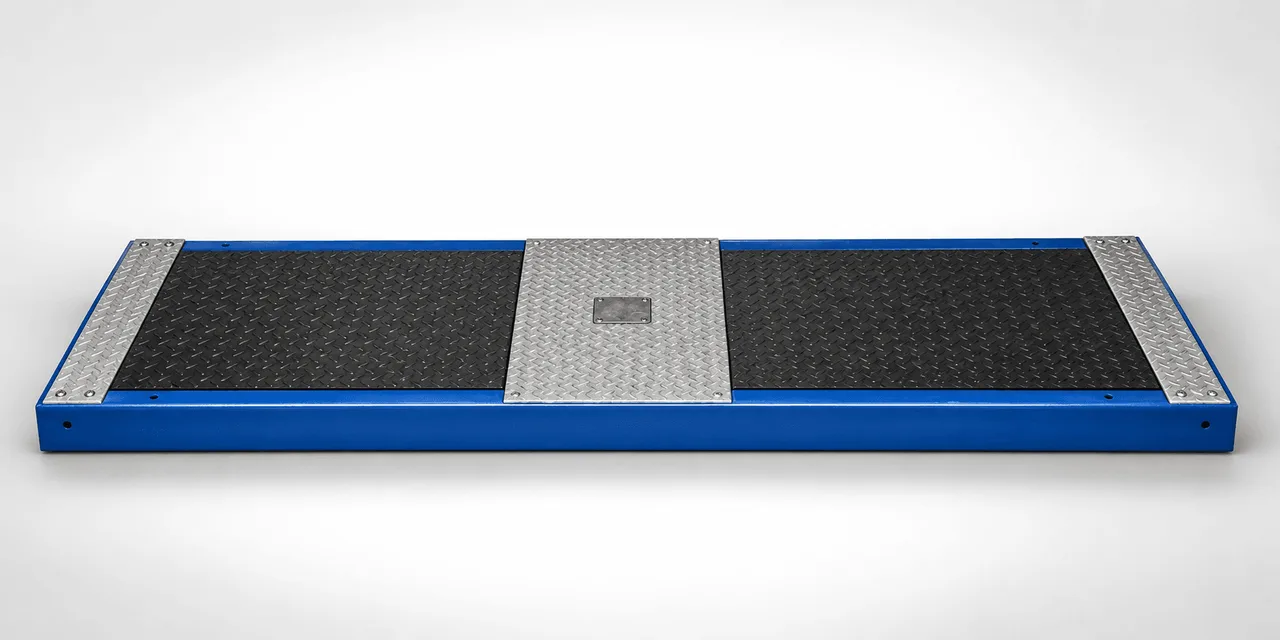
An axle load tester is one of the first benches a vehicle meets in a typical inspection lane.
A 3T lane covers cars, SUVs, and light vans
A 3T roller line is the standard entry point for light-duty testing. It pairs a roller brake tester with sideslip and suspension units, and it captures axle weights and braking balance in seconds. Wear-resistant roller surfaces simulate real tire-to-road friction while protecting tire treads. The test sequence is short by design: a vehicle rolls on, braking force is measured axle by axle, sideslip and suspension values are captured, and the results are pushed to the console before the next car arrives.
A 15T lane handles trucks, coaches, and trailers
Heavy transport demands structural rigidity that light-duty frames cannot offer. A 15T line uses reinforced frames, high-torque drive motors, and strain-gauge sensors that measure braking force accurately under maximum load. For multi-axle vehicles, pair the main bench with auxiliary free rollers to prevent transmission binding during drive-axle tests — otherwise the driveline can resist the rollers and corrupt the reading. Heavy-gauge welded steel with corrosion-resistant finishes also matters here, because these lanes see continuous high-tonnage traffic that would distort a lighter frame over time.
A dedicated emission line covers petrol, diesel, and hybrid fleets
Emission testing is now a permanent part of every comprehensive inspection line, not an optional add-on. A mobile source five-parameter comprehensive tester measures regulated tailpipe gases in real time. For diesel vehicles, an opacimeter captures smoke density and light absorption during both snap-acceleration and loaded cycles, so the result reflects real operating conditions rather than idle exhaust alone. Exhaust extraction and ventilation belong in the plan from day one, since high-idle testing fills a closed bay with fumes quickly.
Five test systems make up a complete inspection lane
A compliant station does not rely on one brand of tester. It integrates five subsystems, and each one answers a specific question about the vehicle. When one system is missing, the report is incomplete even if every installed unit is calibrated.
Brake and axle load testing
Roller brake testers and plate systems measure braking force distribution, ovality, and efficiency. Axle load testers verify weight distribution under dynamic conditions. Together they answer the most safety-critical question: can this vehicle stop safely, and does it brake evenly across its axles? An imbalance between left and right wheels may pass a visual check but still pull the vehicle into another lane under hard braking. That is why automated sequencing starts here.
Start with your vehicle tonnage and required accuracy. The table below lists the main models in Cartesy's brake and axle load range, covering passenger cars through to 15-tonne heavy configurations:
| Equipment | Representative model | Max axle load | Key measuring range | Indication error |
|---|---|---|---|---|
| Roller brake tester | CTFZ series | 3–15 t | Max brake force 35 kN (10 t model) | ≤ ±3% |
| Load-lift brake tester | CTFZ-15JZ | Wheel load up to 7.5 t | Max brake force 39 kN, lift stroke 100 mm | ≤ ±1% |
| Luxury flat brake tester | CTHPB series | 3–13 t | Brake force 10–45 kN, speed 5–10 km/h | ≤ ±3% |
| Ultra-thin flat brake tester | CTPB series | 3–10 t | Sideslip range 0–±15 m/km | ≤ ±3% |
| Axle (wheel) load tester | CTZZ-3 / 10 / 15 | 3 / 10 / 15 t | Wheel load 0–1500 / 5000 / 7500 kg | — |
| Multi-axle load tester | CTZZ-13-4 / -6 | 3×10 t | Platform 2×4000×1150 mm (4-type) | — |
| Kerb mass tester | CTZZ-15-4 | 3×10 t | Platform 2×4000×1150 mm | — |
Flat brake testers can be surface-mounted without a 380 V power supply, which suits sites with limited excavation. Roller types need a pit but simulate sustained braking. For heavy trucks, choose the load-lift type: hydraulic rams apply load to each axle and reveal brake fade that a standard bench cannot detect.
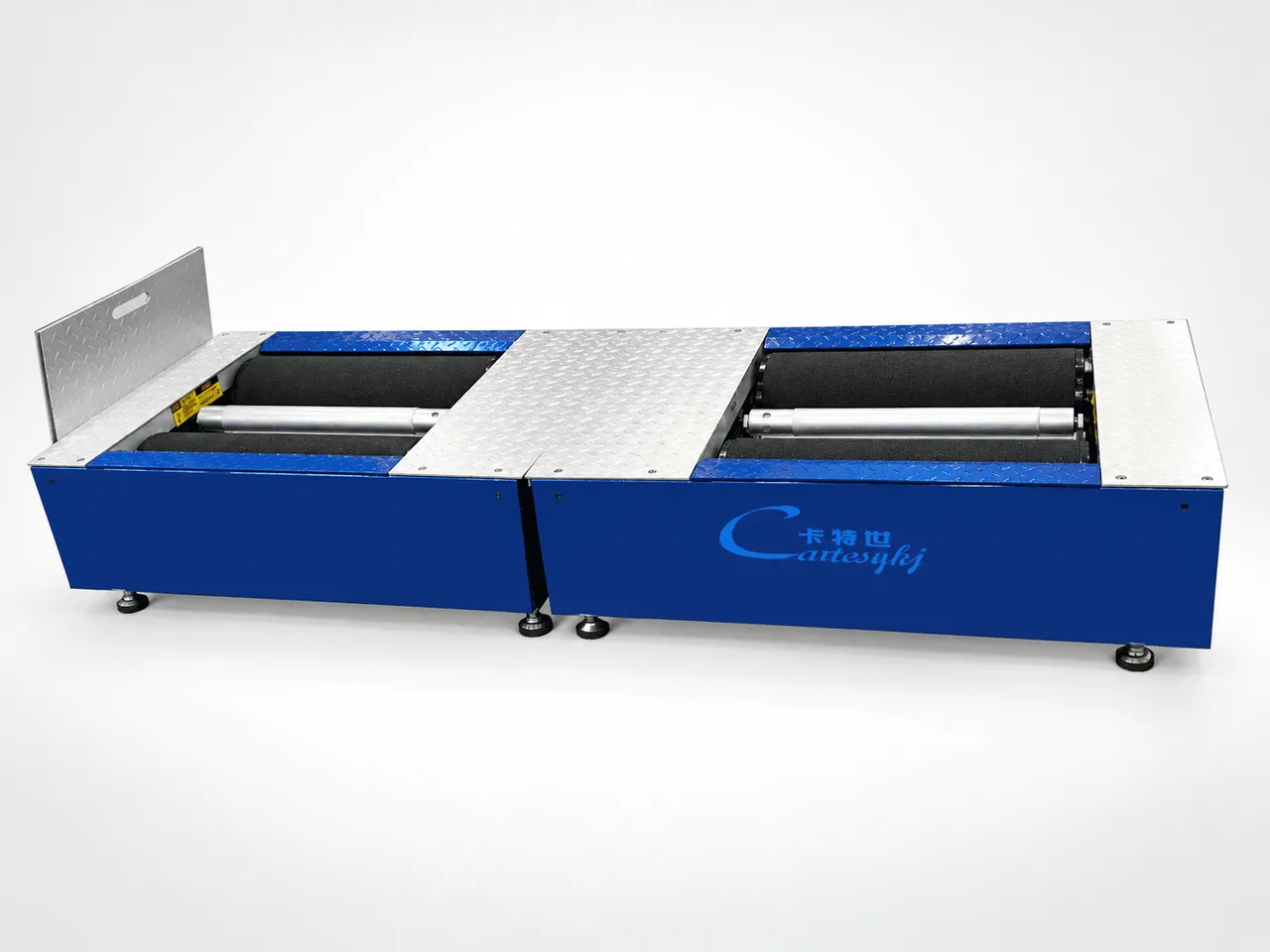
The roller brake tester measures braking force axle by axle in a matter of seconds.
Sideslip, suspension, and steering geometry
Sideslip testers detect wheel drift as the vehicle rolls across a slip plate. Suspension and damping benches measure how quickly the body settles after a disturbance. Steering angle testers confirm that front-wheel alignment stays within tolerance. These units catch frame distortion and worn steering components early, before they become a driver complaint or a collision risk. Supporting tools such as a vehicle kerb mass tester and a sideslip and tracking gauge extend the same check to loaded vehicles and unusual axle layouts.
This group is selected on axle-load coverage and repeatability. The table below lists the main parameters of Cartesy's sideslip, suspension, and steering range:
| Equipment | Representative model | Max axle load | Key range / frequency | Accuracy / indication error |
|---|---|---|---|---|
| Sideslip tester | CTCH-3 / 10 / 15 | 3 / 10 / 15 t | Range ±15 m/km | Synchronization error < 0.04 mm |
| Suspension tester | CTXX-3 / 10 | 3 / 10 t | Excitation frequency ≥ 23 Hz | Absorption repeat error ≤ 2% |
| Shock absorption and damping tester | CTZN-3 | Test axle load 2.5 t | Test frequency 2–11.5 Hz | Indication accuracy 2% |
| Automatic steering angle tester | CTZJ-13-2 | 13 t | Steering angle 0–50°, resolution 0.1° | Measuring accuracy 2% FS |
A sideslip bench works well as a pre-check before wheel alignment, telling you whether the car needs aligning at all and saving shop time. The suspension tester uses the EUSAMA standard, where a higher absorption ratio means better damping; the damping tester applies an AI algorithm to calculate the shock absorber coefficient directly and can pick up abnormal undercarriage noise. The steering angle tester's turntables self-center and move electrically, then return to zero automatically after the test so a driven vehicle cannot damage the platform.
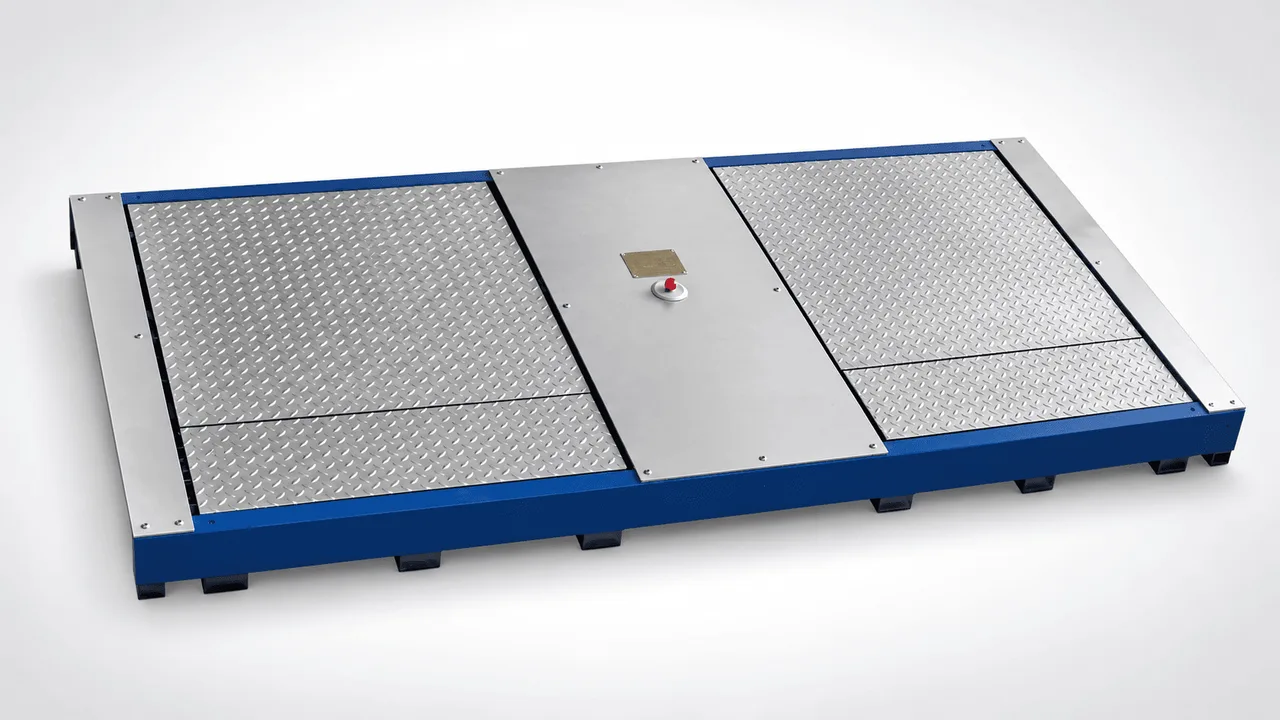
A sideslip plate detects wheel drift as the vehicle rolls across it.
Chassis play and undercarriage diagnosis
Axle play detectors reveal joint wear and loose chassis points under load. For a deeper look, a full automatic undercarriage scanner and tread depth tester can inspect the underside and tire condition in a single drive-through cycle. This is where modern undercarriage diagnosis adds real value for salvage vehicle inspection, because hidden structural damage often sits below the body where a visual walk-around never reaches. A chassis dynamometer adds another layer by measuring power delivery under load, which exposes driveline faults that a static brake test cannot see.
This group determines how deep you can see into the chassis. The table below lists the main parameters of Cartesy's undercarriage diagnosis range:
| Equipment | Representative model | Allowable axle load | Key range | Accuracy / feature |
|---|---|---|---|---|
| Chassis play detector | CTJX-3 / 13 | 3 / 13 t | Platform travel ±50 mm, speed 60–80 mm/s | Max force 20 kN, wireless remote |
| Automatic undercarriage and tread scanner | CTLTT-3 | 0–4 t | Tread depth 0–25 mm, track width 700–2200 mm | Accuracy 0.01 mm, vision + laser non-contact |
| Chassis dynamometer | CTDCG-3 / 10 / 13 / 15 | 3 / 10 / 13 / 15 t | Max absorption 160–350 kW, top speed 130–160 km/h | Roller adhesion coefficient ≥ 0.92 |
The play detector uses hydraulics to move two plates longitudinally and laterally, letting an operator check tie rods, ball joints, and steering arms by remote control — the left plate moves fore, aft, and sideways, the right plate fore and aft. The undercarriage scanner uses vision and laser technology to complete a scan at low speed without removing wheels or lifting the vehicle, and it flags abnormal tread automatically. The dynamometer covers four axle-load classes from passenger cars to 15-tonne trucks, with precision-balanced rollers and adjustable side rollers that stop a front-wheel-drive car from sliding sideways under test.
An automatic undercarriage scanner inspects the underside in a single drive-through cycle — especially useful for rebuilt and imported vehicles.
Emission and optical testing
Beyond gas analysis, headlight aimers measure beam intensity, deviation, and focal alignment for halogen, xenon, and LED systems. Sound level meters record drive-by noise to confirm compliance with urban environmental rules. Connected to the central console, these tools complete the official inspection record. Ancillary instruments such as pedal and hand lever force sensors confirm that the effort applied by the inspector stays within the range that validates the brake efficiency result.
Emission and optical products span many models. The table below lists representative Cartesy machines by test object and their core parameters:
| Equipment | Representative model | Key range | Indication error / accuracy | Standard |
|---|---|---|---|---|
| Petrol exhaust analyzer | MQW-50A / 5105 | HC 0–9999 ppm, CO 0–15.00% | ±3% (low range) | GB 18285, OIML R99 class 00 |
| Diesel exhaust analyzer | MQW-5102 / 5102(Z) | CO₂ 0–18%, NO 0–5000 ppm | NO ±25 ppm or ±4% | GB 3847 |
| Opacity smoke meter | MQY-201 / 202 / 210 | Opacity 0–99.9%, absorption 0–16.08 m⁻¹ | ±2.0% | GB 3847 |
| Five-parameter mobile source tester | MQY-5C | Temp −20 to 60 °C, RH 0–95%, pressure 40–110 kPa, rpm 500–6000 | Temp ±0.5 °C, rpm ±1% | GB 18285 / 3847 |
| Headlight tester | MQD-6A / 5A / 3C | Luminous intensity 0–120000 cd, axis deviation ±56 cm/dam | Intensity ±10%, deviation ±3.2 cm/dam | GB 7258, GB 38900 |
| Exhaust flow analyzer | ML-100 | Flow 4–12 m³/min, O₂ 0–25%, temp −30 to 150 °C | Flow ±4% F·S, temp ±1 °C | Replaces imported flowmeters |
Exhaust analyzers use non-dispersive infrared for CO, HC, and CO₂, and electrochemical cells for O₂ and NO, then calculate the excess air ratio λ. Smoke meters use an "air curtain" to protect the optics and hold the measurement chamber at constant temperature to prevent condensation. The headlight tester uses dual-CCD technology for halogen, xenon, and LED lamps, completing an average beam check in about 25–40 seconds, with optional Bluetooth and a built-in printer.
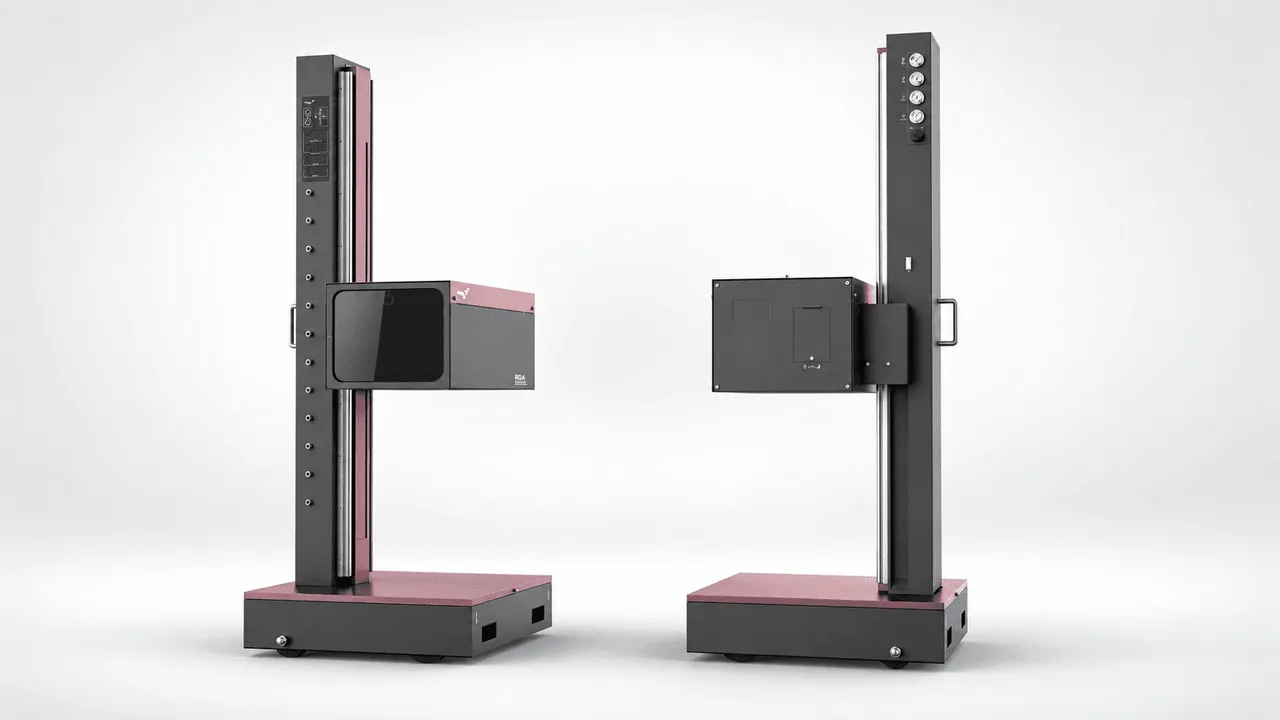
A dual-CCD headlight tester checks beam intensity and axis deviation for halogen, xenon, and LED lamps.
Site and power specs decide your daily throughput
Good equipment cannot compensate for a poor layout. The physical plan determines how many vehicles you can process in a shift and whether your results stay accurate over years of daily use. Design the building around the test sequence, not the other way around.
Build a straight-line, drive-through flow
Design separate entry, testing, and exit zones so light and heavy vehicles never cross paths. Cartesy's site specifications (2026) recommend a minimum lane height of 4.5 m and a lane width of 4.0 m. Floor leveling must stay under 2 mm of gradient deviation per meter, otherwise sideslip and headlight readings drift out of tolerance. A uni-directional straight-line layout removes turning delays and the congestion that builds up when a vehicle has to reverse out of a bay. Pre-cast pit frames and calculated sensor spacing let consecutive vehicles advance without electronic or physical interference.
Prepare pits, power, and compressed air
Stationary lines need reinforced concrete pits with precision mounting frames for brake testers, play detectors, and suspension units. Where excavation is restricted, surface-mounted options are available, though they demand a level slab. Plan for these utilities from day one:
- Electrical — dedicated three-phase industrial supply at 380 V / 400 V, 50/60 Hz, with local surge suppression to protect sensitive load cells.
- Pneumatic — regulated compressed air at 6–8 bar for joint play detectors, air-assisted lifts, and motorcycle clamping systems.
- Environmental — exhaust extraction, oil-water separator drainage along the pit floor, and adequate ventilation for high-idle emission runs.
Centralized software turns readings into defensible reports
Modern vehicle inspection station software collects real-time data from every connected sensor and routes it into one database. This matters for two reasons. First, it removes manual logging errors, which are the most common source of disputed results. Second, it protects diagnostic integrity by limiting operator tampering and time-stamping every measurement at the moment it is taken.
Results are formatted to match regional statutory standards or private workshop management systems, then issued as a single official report. Automated wheel-slip detection, safety start protections, and emergency stop circuits run through the same control layer, so the software is also part of your safety case. When you evaluate suppliers, ask to see the report template and the data-export format. If the software cannot produce the exact document your authority expects, the hardware credentials do not matter.
Plan for maintenance access as well. Low-maintenance drive units with durable gearboxes reduce mechanical wear and shorten scheduled downtime, while standardized mechanical and electrical interfaces make it far easier to add a lane later or swap a failed sensor without rewiring the whole bench.
Licensing comes from process, not equipment alone
Buying certified testers is only half the compliance picture. Your station, your inspectors, and your procedures all need to satisfy local rules. Most vehicle inspection requirements cover the same ground:
- Station licensing — facility approval, calibrated equipment, recorded maintenance intervals, and a documented test sequence.
- Inspector qualification — trained technicians who can operate each bench, interpret borderline results, and apply the correct fail criteria.
- Emissions authorization — in many regions, only registered emissions repair technicians may perform or sign off certain tests.
- Compliance updates — standards change, so budget for recalibration and staff retraining each year rather than treating certification as a one-off cost.
Because safety systems inspections are regulated differently in every market, confirm current requirements with your local transport authority before you commit capital. Requirements and fees vary by country and change over time; this guide is informational, not legal advice.
Match the station to your business case
Not every operator needs a full multi-lane facility. Three scenarios cover most investments, and each one changes which equipment earns its keep.
An auto repair shop can add a lane to existing bays
An auto repair shop with steady diagnostic demand can integrate a compact test lane into current operations. A modular line connects to the pit layout you already have, and the software can feed results straight into your workshop management system. This approach adds a revenue stream without a full site rebuild. It also shortens the hand-off between diagnosis and repair, because the same technician can move from the tester to the work bay without re-keying data.
A salvage vehicle inspection needs extra documentation
Rebuilt and imported vehicles require a deeper paper trail. Combine axle play detection, undercarriage scanning, and emission testing, then archive every result with a timestamp and vehicle identifier. The test record protects you if a vehicle's condition is later disputed, and it gives insurers the evidence they need to assess a rebuilt title.
A fleet or government hub needs scale
Fleet depots and regulatory agencies benefit from multi-lane, high-throughput configurations with reinforced frames and centralized data. Cartesy has deployed inspection lines across Vietnam, the Philippines, Kenya, Myanmar, and Cambodia, which shows how the same modular approach adapts to different climates and vehicle mixes. A turnkey supplier also handles site assessment, civil works supervision, machine commissioning, and software calibration, so your facility launches on schedule instead of stalling between vendors.
Frequently asked questions
What core systems make up standard vehicle inspection station equipment? A complete lane combines roller brake testers and plate systems, sideslip and suspension testers, axle play detectors, emission analyzers, and headlight aimers, all linked to a central console. Optional modules cover steering angle, chassis dynamometer testing, and undercarriage scanning.
Can one lane handle both passenger cars and commercial fleets? Yes. Modular lines pair light-duty benches with reinforced, wide-track rollers and high-capacity sensors for heavier axle loads. Most operators route by weight at check-in so each vehicle reaches a lane built for it.
How does modern equipment handle electric vehicles? EVs present different axle loads and regenerative braking patterns that legacy units can misread. Updated sensor algorithms and EV-specific hardware evaluate battery-electric and hybrid platforms without damaging drivelines.
How long does a typical inspection take? A single vehicle moves through a well-planned lane in minutes, not hours. Straight-line flow, automated data capture, and consistent scheduling are the three biggest factors.
What preparation is required before installation? Plan reinforced pit excavation or pre-cast foundations, sensor conduits, floor drainage, and three-phase power before the equipment arrives. Confirm lane height and width against the specifications above.
Can I add lanes later? Standardized mechanical and electrical interfaces are designed for expansion. Ask your supplier to document the interface standard so a future lane does not require replacing the existing control system.
Start with a site assessment, not a quote
The right vehicle safety inspection station starts with your vehicle mix, your floor plan, and your local licensing rules. Get those three right and the equipment choice becomes straightforward. Get them wrong and even premium hardware will underperform.
Cartesy supplies complete test lanes from 3T to 15T, emission systems, undercarriage scanners, and centralized software. Our team can review your site dimensions, recommend a configuration, and prepare a tailored proposal.
Talk to our engineering team about your station layout →
Regulatory note: Inspection rules, licensing, and fees differ by jurisdiction. Confirm current vehicle inspection requirements with your local authority before investing.