
Brake & Axle Load Testing Equipment
Multi-Axis Vehicle Axle (Wheel) Load Tester
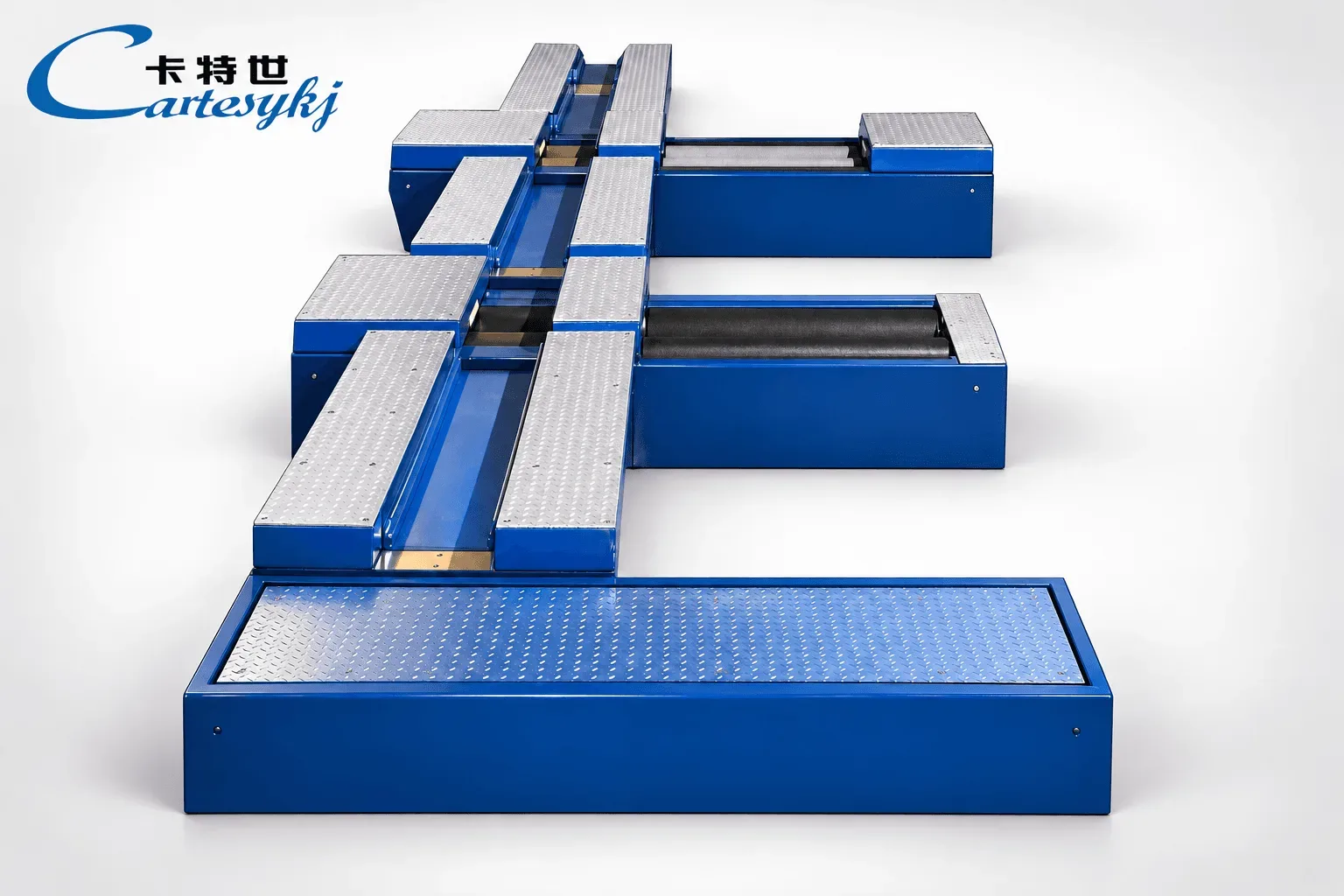
CTZZ-13-4/CTZZ-13-6 Miscalculating vehicle brake efficiency on an inspection line creates immediate compliance liabilities and bottlenecks station throughput. Because braking force ratios depend directly on accurate ver...


|CTZZ-13-4/CTZZ-13-6
Miscalculating vehicle brake efficiency on an inspection line creates immediate compliance liabilities and bottlenecks station throughput. Because braking force ratios depend directly on accurate vertical load data, an axle load tester serves as the foundational weighing instrument in a vehicle safety inspection lane. The Cartesykj CTZZ series Vehicle Axle (Wheel) Load Tester measures front and rear axle load distribution, individual wheel mass, and complete vehicle mass. Engineered with an integrally welded body, split-structure anti-slanting geometry, and strain-type sensors, this equipment supports low-speed drive-through testing without requiring anchor bolts during installation.
In this engineering and procurement guide, facility managers and inspection line planners will review the exact technical parameters of the single-axle CTZZ-3, CTZZ-10, and CTZZ-15 models alongside the multi-axis CTZZ-13-4 and CTZZ-13-6 configurations. We examine verified weighing ranges, tread width tolerances, structural design features, and step-by-step selection criteria for matching an Axle Load Tester to your vehicle fleet profile.
Table of Contents
- Equipment Definition, Measurement Scope, and Industry Applications
- Buyer Value and Operational Considerations for Inspection Lines
- Technology Classifications and CTZZ Series Technical Specifications
- Structural Materials, Sensor Architecture, and Compliance Standards
- Practical Sourcing and Risk-Mitigation Guide for Buyers
- Frequently Asked Questions (FAQ)
- Conclusion and Engineering Consultation
Equipment Definition, Measurement Scope, and Industry Applications
An axle load tester—also referred to in inspection facilities as a vehicle axle (wheel) load tester—is a specialized weighing instrument designed to separately measure the front and rear axle load distribution of motor vehicles. More specifically, the apparatus determines the vertical load exerted by each individual wheel onto the ground plane. In automated vehicle test lanes, this measured weighing value is a primary input variable required for the mathematical calculation of vehicle brake efficiency.
Axle Load Tester vs. Wheel Load Tester vs. Axle Load Tester
Procurement specifications often use three overlapping terms when describing vehicle weighing systems. Understanding how they converge in the Cartesykj CTZZ series clarifies equipment budgeting:
- Axle Load Tester: Focuses on capturing the combined vertical load of a complete front or rear axle assembly to evaluate longitudinal weight distribution across the chassis.
- Wheel Load Tester: Measures the individual vertical mass at each left and right tire contact patch, revealing side-to-side load imbalances that could induce brake pull.
- Axle Load Tester: Refers to the complete mechanical weighing platform, split-structure frame, strain sensors, and instrument control system installed in the inspection bay floor or across an inspection pit.
Rather than requiring separate stations, the Cartesykj vehicle axle (wheel) load tester integrates all three capabilities into a single platform. It simultaneously determines wheel mass, axle load mass, and total vehicle mass during a single low-speed pass.
Core Application Scope in Automotive Testing
When working with an Automotive Inspection Station Equipment Supplier, facility planners deploy these weighing platforms across several distinct operational environments:
- Statutory Vehicle Safety Inspection Stations: Deployed as core automotive testing equipment to capture baseline curb mass and axle weights prior to roller brake testing.
- Multi-Axis Commercial Truck and Bus Lanes: Using extended-plate models (CTZZ-13-4 and CTZZ-13-6) to weigh dual-axis or tri-axis tandem wheel groups simultaneously on a single weighing plate in accordance with GB21861-2014 curb mass protocols.
- Commercial Fleet Maintenance and Repair Centers: Diagnosing suspension sagging, uneven chassis loading, and weight-related braking anomalies before returning heavy vehicles to road service.
- Integrated Brake Testing Lines: Feeding real-time axle mass data into the station's central instrument control system so that brake force-to-axle-load percentages are computed automatically without manual data entry.
Buyer Value and Operational Considerations for Inspection Lines
Selecting an axle load tester directly impacts civil engineering preparation costs, daily vehicle inspection throughput, and long-term calibration stability. Below are the primary operational drivers supported by the mechanical design of the CTZZ series.
Civil Work Reduction via Bolt-Free Installation
Traditional pit-mounted inspection equipment often demands deep concrete anchor bolts, secondary grouting, and extended curing times that halt lane operations. The Cartesykj CTZZ series is engineered so that no anchor bolt is required for installation. This mechanical layout simplifies civil foundation interfaces and makes on-site installation and debugging convenient and fast—reducing initial commissioning downtime for new or retrofitted test lanes.
Throughput Optimization with Low-Speed Drive-Through Testing
In high-volume inspection stations, stopping every vehicle on a static scale to stabilize readings creates severe queue congestion. The CTZZ platform incorporates a low-speed drive-through testing mode (pass-through measurement mechanism). Vehicles roll across the weighing plates at a controlled low speed while the instrument control system captures wheel and axle loads dynamically, keeping detection efficiency extremely high across busy commercial and passenger lanes.
Calculation Accuracy for Brake Efficiency
Under standard vehicle inspection protocols, raw braking force measured in Newtons (or daN) on a roller brake tester cannot determine pass/fail status alone; it must be divided by the vertical load of the tested axle or wheel. The fundamental relationship used by inspection control systems is:
Axle Brake Efficiency (%) = Total Axle Braking Force / (Measured Axle Load × Gravity Constant) × 100%
If the Wheel Load Tester introduces measurement drift due to platform tilting or off-center tire entry, the denominator in this equation becomes inaccurate, leading to false rejections or undetected safety hazards. The CTZZ series addresses this operational risk by combining a split-structure frame with an anti-slanting weighing design, ensuring that eccentric wheel loads do not distort the vertical force vector transmitted to the sensors.
Technology Classifications and CTZZ Series Technical Specifications
Vehicle inspection lanes handle vastly different chassis footprints, ranging from compact passenger cars to multi-axle heavy freight trucks. To match these varying footprints without overbuilding foundation pits, Cartesykj categorizes its axle load tester lineup into two distinct architecture classes: standard single-axle pass-through testers (CTZZ-3, CTZZ-10, CTZZ-15) and multi-axis tandem axle testers (CTZZ-13-4, CTZZ-13-6).
Standard Single-Axle Models: CTZZ-3, CTZZ-10, and CTZZ-15
The standard CTZZ series is designed to measure individual axles sequentially as the vehicle drives over the dual left-and-right weighing plates. Buyers select between 3,000 kg, 10,000 kg, and 15,000 kg maximum passing axle loads depending on whether the lane serves light passenger vehicles, medium commercial vans, or heavy single-axle trucks.
Technical Parameter
Model CTZZ-3
Model CTZZ-10
Model CTZZ-15
Max. Passing Axle Load (kg)
3000
10000
15000
Wheel Load Measuring Range (kg)
0–1500
0–5000
0–7500
Weighing Plate Dimensions (mm)
800 × 500
1000 × 800
1100 × 800
Tread Inside / Outside Width (mm)
700 / 2400
700 / 2700
700 / 2900
Overall Installation Dimensions (mm)
2700 × 660 × 200
3000 × 960 × 220
3000 × 960 × 220
Control System
Instrument Control
Instrument Control
Instrument Control
Notice the progression in physical footprint: while the CTZZ-10 and CTZZ-15 share identical overall installation dimensions (3000 × 960 × 220 mm), the CTZZ-15 expands the individual weighing plate length to 1100 × 800 mm and extends the maximum outside tread capacity to 2900 mm to accommodate wider heavy-duty commercial axles and larger tire contact patches.
Multi-Axis Vehicle Axle (Wheel) Load Testers: CTZZ-13-4 and CTZZ-13-6
Heavy commercial trailers and trucks frequently utilize dual-axis (tandem) or tri-axis (tridem) closely spaced axle groups. Weighing one axle of a tandem group on a short plate while the adjacent axle rests on the concrete approach floor can introduce suspension binding and load transfer errors. Developed in accordance with the GB21861-2014 standard to measure total vehicle curb mass, the CTZZ-13-4 and CTZZ-13-6 models utilize elongated weighing plates (4,000 mm and 6,000 mm in length) so that all same-side wheels of a dual-axis or tri-axis tandem group stand simultaneously on a single weighing plate.
Technical Parameter
Model CTZZ-13-4
Model CTZZ-13-6
Rated Axle Load Capacity
3 × 10000 kg
3 × 10000 kg
Weighing Plate Size (mm)
2 × 4000 × 1150 mm
2 × 6000 × 1150 mm
Supported Tread Width (mm)
700 (inner) × 3000 (outer)
800 (inner) × 3000 (outer)
Applicable Standard
GB21861-2014
GB21861-2014
Pit Installation Option
Optional installation on both sides of the pit
Optional installation on both sides of the pit
Structural Materials, Sensor Architecture, and Compliance Standards
The service life and metrological stability of an Axle Load Tester depend on how the mechanical chassis resists bending moments and how the sensing elements process vertical force under repeated dynamic loading.
Integrally Welded Body and Split-Structure Frame
Every Cartesykj axle load tester features an extra-strong structural body that is welded as a whole. Integral welding eliminates bolted structural joints in the primary load-bearing frame that could loosen under continuous heavy truck traffic, providing high mechanical strength and long-term durability. In addition, the platform utilizes a split-structure design paired with an anti-slanting weighing mechanism. This mechanical isolation prevents horizontal braking forces or lateral tire scrubbing from cross-coupling into the vertical load reading, ensuring stable and repeatable measurement results.
High-Precision Strain-Type Sensor Configuration
To convert mechanical deflection into electrical weight signals, the CTZZ series is equipped with brand-name, high-precision strain-type sensors. On the multi-axis CTZZ-13-4 and CTZZ-13-6 units, balanced high-precision sensors distribute the load evenly across the 4-meter or 6-meter decks. These sensors are interfaced directly with a dedicated instrument control system that processes individual wheel mass, summed axle load mass, and accumulated vehicle mass during the pass-through cycle.
Regulatory Standard Alignment (GB21861-2014)
For inspection facilities operating under Chinese motor vehicle safety technical inspection frameworks or equivalent international curb-weight audit regimes, the multi-axis CTZZ-13-4 and CTZZ-13-6 models are explicitly engineered according to GB21861-2014 (Specification for safety technical inspection of motor vehicles). The ability to place all wheels on one side of a dual-axle or tri-axle assembly onto a single continuous plate satisfies regulatory requirements for measuring accurate vehicle curb mass without multi-axle suspension interference.
Practical Sourcing and Risk-Mitigation Guide for Buyers
Before issuing a purchase order to an Automotive Inspection Station Equipment Supplier, engineering and procurement teams should audit their facility geometry and fleet data against the hardware specifications below.
Step-by-Step Model Selection Criteria
- Audit Maximum Axle Weight vs. Measuring Range: Identify the heaviest axle in your target inspection fleet. For passenger cars and light duty vans, the CTZZ-3 (3,000 kg max passing load; 0–1,500 kg wheel range) prevents overspending. For mixed municipal lanes, the CTZZ-10 covers up to 10,000 kg per axle (0–5,000 kg per wheel). For heavy single-axle commercial trucks, specify the CTZZ-15 (15,000 kg max passing load; 0–7,500 kg wheel range).
- Evaluate Multi-Axle Curb Mass Requirements: If your station inspects heavy commercial trucks with dual-axis or tri-axis close-coupled bogies and requires GB21861-2014 curb mass verification, select the CTZZ-13-4 (2 × 4000 × 1150 mm plates) or CTZZ-13-6 (2 × 6000 × 1150 mm plates) rated at 3 × 10,000 kg.
- Verify Minimum and Maximum Track (Tread) Widths: Compare the inner and outer tire spacing of your narrowest and widest vehicles against the tester's tread limits. Standard models support an inner tread of 700 mm and outer treads of 2400 mm (CTZZ-3), 2700 mm (CTZZ-10), or 2900 mm (CTZZ-15). Multi-axis models accommodate outer treads up to 3000 mm, with an inner tread of 700 mm on the CTZZ-13-4 and 800 mm on the CTZZ-13-6.
- Confirm Pit and Foundation Dimensions: Check civil trench depth and width against the overall installation dimensions: 2700 × 660 × 200 mm for the CTZZ-3, or 3000 × 960 × 220 mm for the CTZZ-10 and CTZZ-15. If your inspection lane uses an under-chassis inspection pit, note that the multi-axis models can be optionally configured for installation on both sides of the pit.
General Buyer Checklist for Total Cost of Ownership (TCO) and Risk Mitigation
Note: The following procurement verification points represent general industrial best practices for buyers evaluating vehicle weighing equipment.
- Civil Foundation Levelness: Even though the CTZZ series requires no anchor bolts for installation, buyers should verify that the supporting concrete pad is cast flat and level so the split-structure frame and strain sensors sit uniformly without shimming stress.
- Control System Integration: Confirm communication protocols between the tester's instrument control system and your existing lane management software or roller brake tester so wheel load values transfer seamlessly for brake efficiency calculations.
- Drainage and Debris Clearance: In recessed floor installations, ensure pit drainage prevents standing water or mud buildup around the strain-type sensors and beneath the weighing plates.
Frequently Asked Questions (FAQ)
What is the difference between the CTZZ-3, CTZZ-10, and CTZZ-15 axle load testers?
The primary differences are load capacity, weighing plate size, and outer tread width. The CTZZ-3 handles a maximum passing axle load of 3,000 kg (0–1,500 kg wheel load range) with 800 × 500 mm plates and a 700/2400 mm tread. The CTZZ-10 handles up to 10,000 kg (0–5,000 kg wheel range) with 1000 × 800 mm plates and a 700/2700 mm tread. The CTZZ-15 handles up to 15,000 kg (0–7,500 kg wheel range) with 1100 × 800 mm plates and a 700/2900 mm tread.
Why is a wheel load tester necessary for brake testing lines?
A vehicle axle (wheel) load tester measures the vertical load of each wheel and the front/rear axle load distribution. This measured weighing value is an essential mathematical factor required to calculate vehicle brake efficiency when paired with braking force measurements on an inspection line.
Does the Cartesykj axle load tester require anchor bolts for installation?
No. The CTZZ series is designed so that no anchor bolt is required for installation. This structural feature makes on-site installation and debugging convenient and quick while simplifying foundation work.
When should an inspection station choose the CTZZ-13-4 or CTZZ-13-6 multi-axis tester?
Stations should choose the CTZZ-13-4 or CTZZ-13-6 when they need to measure total vehicle curb mass in accordance with the GB21861-2014 standard, or when testing commercial vehicles with dual-axis or tri-axis tandem axles. The extended plates (2 × 4000 × 1150 mm or 2 × 6000 × 1150 mm) allow all same-side wheels of a dual or tri-axle group to be measured simultaneously on a single weighing plate, and can optionally be installed on both sides of an inspection pit.
What metrics can the CTZZ series measure during a single pass?
Using its low-speed drive-through testing mode and high-precision strain-type sensors, the equipment can measure individual wheel mass, single or multi-axle load mass, and total vehicle mass.
Conclusion and Engineering Consultation
Selecting an accurately sized axle load tester safeguards the integrity of your brake efficiency calculations while keeping vehicle inspection queues moving rapidly. Whether your facility requires the compact 3,000 kg CTZZ-3 for passenger vehicles, the heavy-duty 15,000 kg CTZZ-15 for commercial trucks, or a GB21861-2014 compliant CTZZ-13-6 multi-axis platform installed along both sides of an inspection pit, Cartesykj provides integrally welded, bolt-free weighing solutions built around high-precision strain sensors.
Ready to specify an Axle Load Tester for your inspection line? Contact the Cartesykj engineering team today with your target vehicle axle weights, tread width ranges, and bay layout dimensions to request technical drawings, control system integration details, or a tailored equipment quotation.
Related Products
Compare related inspection systems
Brake & Axle Load Testing Equipment
Motorcycle Brake Tester | CTJZMT-300B/CTMT-750 / CT3JZMT-750
View Product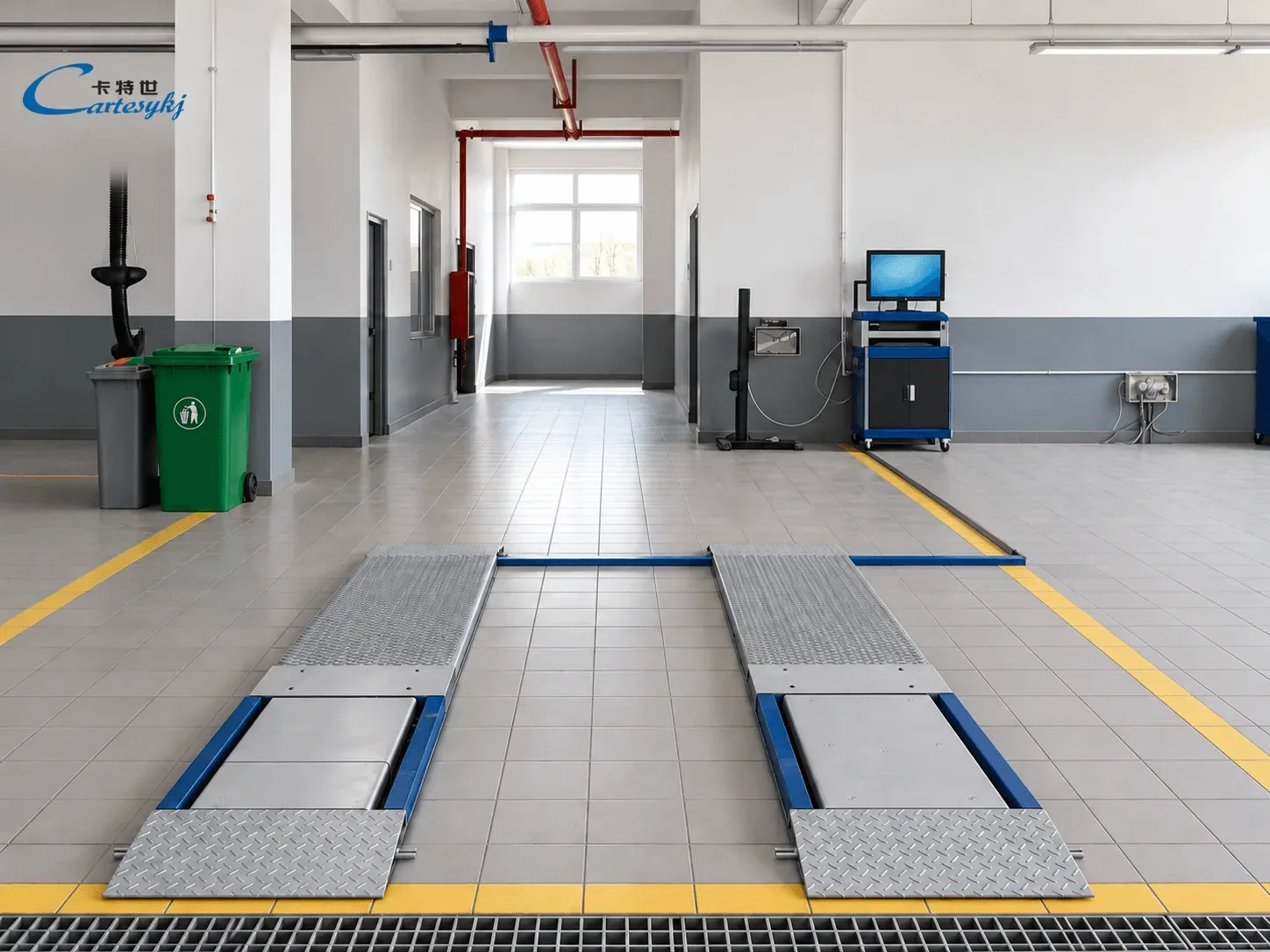
Request a Quote
Request configuration and pricing for your project.
Share your vehicle type, inspection lane layout, target capacity, and required model configuration for Multi-Axis Vehicle Axle (Wheel) Load Tester.
Share the project location, vehicle types, inspection scope, applicable standards, target throughput, site conditions and current stage. We will confirm the configuration scope before discussing pricing.