
Wheel, Tire & Vehicle Dimension Testing Equipment
Motorcycle (EV) tester for two wheels | CTJZMT-300B
Operating a vehicle inspection lane without verified mechanical instrumentation exposes testing centers to inaccurate defect classification and operational bottlenecks. The Motorcycle Tester serves as an integrated mult...


Operating a vehicle inspection lane without verified mechanical instrumentation exposes testing centers to inaccurate defect classification and operational bottlenecks. The Motorcycle Tester serves as an integrated multi-function testing platform engineered to evaluate two-wheel motorcycles and electric motorcycles under controlled mechanical conditions. By consolidating critical safety metrics—such as brake force, axle load, speedometer verification, and front-to-rear wheel tracking—into a centralized platform, testing stations streamline statutory safety audits while minimizing testing cycle times.
This technical guide details the mechanical configuration, operational workflows, and verified engineering specifications of the Cartesykj CTJZMT-300B platform. Readers will review module-specific tolerances, installation requirements, and baseline selection criteria necessary to build an integrated motorcycle safety inspection line.
Table of Contents
- Verified Equipment Definition and Material/Application Scope
- Buyer Value and Sourcing Considerations Supported by Supplied Facts
- Verified Technology Trends and Classifications
- Documented Materials, Quality Controls, Certifications and Components
- Practical Sourcing and Risk-Mitigation Guidance
- Frequently Asked Questions
- Conclusion
Verified Equipment Definition and Material/Application Scope
The CTJZMT-300B Motorcycle Tester manufactured by Cartesykj is an integrated multi-function testing platform designed specifically for two-wheel motorcycle inspection equipment applications. The system evaluates both internal combustion engine models and electric motorcycles, combining multiple mechanical testing modules into a unified floor-mounted structure. It provides automated and semi-automated assessment capabilities for vehicle inspection stations, motorcycle safety technical inspection centers, municipal compliance lanes, and commercial repair workshops.
The physical footprint of the CTJZMT-300B is defined by overall dimensions of 3540 × 1130 × 280 mm, accommodating a wheel base range between 900 mm and 2800 mm. Its structural chassis supports a rated maximum axle load of 300 kg, making it compatible with mopeds, standard road motorcycles, scooters, and lightweight electric two-wheelers. The platform executes inspection cycles through integrated mechanical subsystems, eliminating the need for independent, free-standing diagnostic rigs for each vehicle check.
Testing Parameter
Standard Metric / Value
Mechanical Configuration / Subsystem
Model Designation
CTJZMT-300B
Integrated multi-function platform
Maximum Axle Load
300 kg
Structural load cell frame
Applicable Axle Distance
900–2800 mm
Adjustable dynamic wheelbase range
Platform Dimensions
3540 × 1130 × 280 mm
Low-profile welded steel chassis
Brake Force Measurement Range
0–2000 N
Twin roller assembly with 1.5 kW motor
Speedometer Measurement Range
0–120 km/h
Twin roller assembly with 2.2 kW motor
Axle Load Testing Range
0–300 kg
Precision integrated load cells
Wheel Alignment Deviation Range
±15 mm
Pneumatic centering clamp (Optional)
Operating Pneumatic Pressure
0.5–0.8 MPa
Shop air connection for lifting/clamping
Core Testing Modules
The integrated layout houses four primary testing modules designed to verify critical vehicle running gear and electrical readouts:
- Motorcycle Brake Force Tester: Utilizes a twin-roller assembly (2 × Ø180 × 300 mm) spaced at a roller center distance of 275 mm. Driven by a 1.5 kW motor, it measures deceleration force within a range of 0–2000 N at an indication error threshold of ±3%. The roller surface maintains an adhesion coefficient of >0.85 under dry conditions and 0.6 under wet conditions to prevent tire slippage during heavy braking.
- Motorcycle Speedometer Tester: Configured with dual rollers (2 × Ø176.6 × 300 mm) at a center distance of 275 mm, powered by a 2.2 kW drive motor. The module measures driven-wheel rotational speeds up to 120 km/h with an indication error within ±2%. A pneumatic lifting mechanism raises and lowers the vehicle between driving and extraction cycles.
- Motorcycle Axle Load / Wheel Weight Tester: Integrated into the platform base to measure static axle mass between 0 and 300 kg. The system delivers a repetition error within ±2% and an overall system accuracy rating of ±2% Full Scale (FS).
- Optional Wheel Alignment Tester: Measures geometric alignment and front-to-rear wheel center line deviation within a range of ±15 mm. The subsystem achieves an indication error of ±0.2 mm using an automatic pneumatic centering clamp capable of securing rim/tire widths from 50 to 230 mm.
Operational Scope and Extended Integration
Beyond vehicle inspection stations and repair facilities, the platform serves motorcycle test equipment manufacturer facilities and research laboratories. For production-line end-of-line audits, the system can support manufacturer-specific testing cycles such as maximum speed verification, acceleration performance, overtaking acceleration tests, and maximum torque evaluation.
When combined with optional external inspection instruments, the CTJZMT-300B forms a complete two-wheel motorcycle safety inspection line. The platform integrates directly with digital headlight testers, exhaust gas analyzers/emission testers, sound level meters, and overhead LED signal display boards for automated operator prompts.
Buyer Value and Sourcing Considerations Supported by Supplied Facts
Procuring specialized inspection hardware requires balance between spatial footprints, installation civil works, and measurement throughput. The CTJZMT-300B addresses key operational challenges commonly encountered in vehicle testing facilities:
- Civil Works Elimination: Conventional inspection equipment often requires deep pits and foundational anchor bolting. The CTJZMT-300B utilizes a high-strength bending and welding structure engineered so that no anchor bolts are required for installation. This drastically cuts facility commissioning downtime and avoids complex civil engineering alterations.
- Floor Space Optimization: Housing the motorcycle brake tester, motorcycle speedometer tester, motorcycle axle load tester, and motorcycle wheel alignment tester within a chassis height of only 280 mm allows compact station layouts, conserving operational floor area.
- Modular Configuration: The platform structure allows testing stations to select base testing modules or include the optional alignment and extended lane accessories depending on regional regulatory requirements.
- Throughput and Operator Safety: Automatic pneumatic clamping and pneumatic lifting systems secure the motorcycle firmly during testing routines, eliminating manual stabilization hazards while speeding up per-vehicle processing times.
- Remote Operation: A wireless remote control system allows technicians to trigger speed testing points and advance inspection steps directly from the vehicle saddle, keeping testing sequences continuous.
Testing Subsystem
Measurement Range
Indication Error / Accuracy
Key Mechanical Specification
Brake Force Tester
0–2000 N
±3%
2 × Ø180 × 300 mm rollers; 1.5 kW motor
Speedometer Tester
0–120 km/h
±2%
2 × Ø176.6 × 300 mm rollers; 2.2 kW motor
Axle Load Tester
0–300 kg
±2% FS (Repetition error: ±2%)
Integrated load sensor array
Wheel Alignment Tester
±15 mm
±0.2 mm
50–230 mm pneumatic clamp; 0.5–0.8 MPa air
Verified Technology Trends and Classifications
The CTJZMT-300B uses variable-frequency control to adjust roller speed during motorcycle speedometer testing. The integrated system supports brake force testing, axle load measurement, speedometer inspection, and optional wheel deviation testing.The CTJZMT-300B embodies this transition through several mechanical and electronic engineering implementations:
- Dynamic Balancing of Rollers: High-speed roller rotation during speedometer evaluation generates harmonic vibrations if not properly counterweighted. The CTJZMT-300B utilizes precision dynamic balancing technology across its Ø176.6 mm and Ø180 mm roller sets, ensuring stable roller rotation up to 120 km/h and extending bearing longevity.
- Surface Adhesion Engineering: Testing brake efficiency requires consistent roller-to-rubber friction. The platform uses specialized roller surface treatments to maintain high friction coefficients (>0.85 dry, 0.6 wet), preventing lockup skidding and false brake-force readings.
- Automated Pneumatic Centering: Manual wheel alignment measurements introduce technician bias. Using a dedicated pneumatic centering clamp operated via standard 0.5–0.8 MPa shop air, the system physically locks the wheel hub along a true axis to measure centerline deviation down to ±0.2 mm.
- EV Powertrain Adaptability: Electric two-wheelers present immediate torque delivery curves that differ from internal combustion models. The combination of variable-frequency control, high-efficiency mechanical speed reducers, and high-precision sensors ensures smooth engagement across different powertrain platforms.
Documented Materials, Quality Controls, Certifications and Components
Structural rigidity and drive-train precision form the core of the Cartesykj CTJZMT-300B test bench. Every unit is manufactured with heavy-duty structural steel plates using precision bending and welding processes to resist mechanical deflection under continuous axle loading.
Critical Mechanical and Electrical Components
- Drive Assemblies: High-efficiency mechanical reducers paired with heavy-duty industrial electric motors (1.5 kW for brake testing, 2.2 kW for speedometer testing) deliver consistent roller drive torque.
- Sensory Array: High-precision load cells and force transducers capture dynamic braking forces up to 2000 N and static wheel masses up to 300 kg.
- Bearing Housings: Heavy-duty industrial bearings support the dynamically balanced roller assemblies, reducing rotational parasitic drag.
- Pneumatic Actuators: Integrated pneumatic cylinders deliver reliable vehicle lifting and clamping forces when connected to standard clean compressed air lines rated at 0.5 to 0.8 MPa.
- Control Processing: A centralized electronic control unit processes digital signals from the speed, weight, and force transducers, transmitting real-time operational data to wireless remotes and external peripheral displays.
Referenced Standards and Technical Baselines
The CTJZMT-300B design, calibration metrics, and safety thresholds reference Chinese national standards GB/T 13563 (roller-type vehicle brake testing equipment) and GB 7258 (technical specifications for motor vehicle operation safety). Compliance with these baselines confirms that brake indication errors remain within the documented ±3% limit and wheel alignment evaluations maintain ±0.2 mm precision.
Practical Sourcing and Risk-Mitigation Guidance
When procuring a Motorcycle Tester for commercial testing lanes or technical inspection centers, procurement teams must evaluate platform parameters against their facility's physical constraints and target vehicle demographics. Consider the following verification steps during procurement planning:
- Wheelbase and Dimension Compatibility: Ensure your inspection line accommodates the full target fleet. The CTJZMT-300B supports axle distances from 900 mm to 2800 mm. Vehicles with wheelbases falling outside these parameters cannot be positioned accurately between the roller assemblies.
- Facility Utility Requirements: Verify on-site electrical supply for the dual drive motors (1.5 kW and 2.2 kW) and confirm that an air compressor capable of delivering continuous 0.5–0.8 MPa clean pneumatic pressure is available adjacent to the installation pad.
- Surface Levelness and Mounting: Although the unit requires no floor anchor bolts, the underlying concrete slab must be level and structurally sound to prevent chassis twisting and maintain ±2% FS load cell accuracy.
- Lane Integration Scope: Determine whether standalone brake, weight, and speed testing are sufficient, or if your local regulatory mandate requires the optional wheel alignment module, headlight tester, sound level meter, and exhaust gas analyzer.
Procurement Specification Summary
The following checklist summarizes the physical and operational boundaries of the Cartesykj CTJZMT-300B to aid in tender drafting and equipment matching:
- Vehicle Type Coverage: Two-wheel motorcycles, scooters, electric motorcycles (EV two-wheelers).
- Weight Capacity: Maximum 300 kg axle load.
- Braking Force Threshold: 0–2000 N measurement window.
- Speed Indication Capacity: Up to 120 km/h driven-roller testing.
- Air Supply Dependency: Dedicated 0.5–0.8 MPa pneumatic line required for lifting and clamping mechanisms.
Frequently Asked Questions
What vehicle types can be inspected on the CTJZMT-300B Motorcycle Tester?
The CTJZMT-300B is engineered for two-wheel motorcycles and electric motorcycles. It accommodates vehicles with a wheelbase between 900 mm and 2800 mm and a maximum axle load not exceeding 300 kg.
Does the motorcycle tester require floor excavation or anchor bolting?
No. The CTJZMT-300B is manufactured with a high-strength bending and welding structural frame designed to operate without anchor bolts. Its low-profile 280 mm height enables straightforward surface installation without specialized pit excavation.
What specific parameters does the integrated brake tester measure?
The brake testing module measures dynamic wheel braking force within a range of 0 to 2000 N, maintaining an indication error within ±3%. Its twin rollers provide a friction coefficient exceeding 0.85 in dry conditions and 0.6 under wet testing conditions.
Can the test bench be integrated into an automated safety inspection line?
Yes. The modular design of the CTJZMT-300B allows integration with peripheral testing devices, including headlight testers, exhaust gas analyzers, sound level meters, and overhead LED signal display boards, forming a complete motorcycle inspection line.
Conclusion
Selecting reliable vehicle testing infrastructure is critical to running an efficient, accurate inspection facility. The Cartesykj CTJZMT-300B Motorcycle Tester delivers a multi-functional testing platform that combines brake, speedometer, axle load, and optional alignment testing modules into an anchor-free steel structure. For comprehensive system layouts, detailed dimensional drawings, or tailored lane integration consultations, contact Cartesykj's engineering team to review technical project specifications.
Related Products
Compare related inspection systems
Wheel, Tire & Vehicle Dimension Testing Equipment
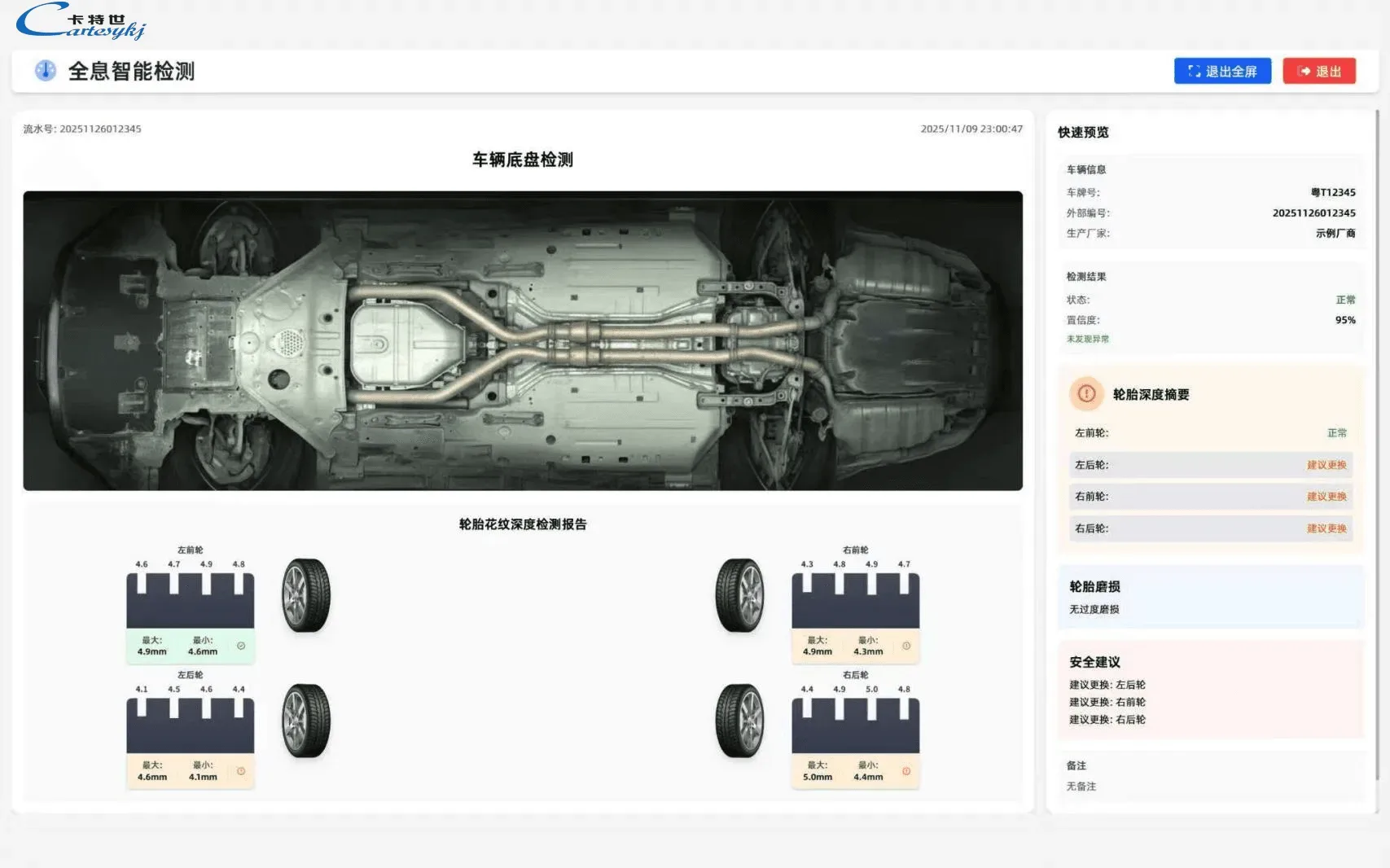
DeepVision:Tire tread Depth & Chassis Holographic Intelligent tester |
View Product
Wheel, Tire & Vehicle Dimension Testing Equipment
Vehicle Dimensions Scanning System | CTWK-C
View ProductRequest a Quote
Request configuration and pricing for your project.
Share your vehicle type, inspection lane layout, target capacity, and required model configuration for Motorcycle (EV) tester for two wheels | CTJZMT-300B.
Share the project location, vehicle types, inspection scope, applicable standards, target throughput, site conditions and current stage. We will confirm the configuration scope before discussing pricing.