
Speedometer & Roller Auxiliary Equipment
Motorcycle (EV) Speedometer Tester for Two & Three Wheels | CTMT-750 /CT3JZMT-750
Inaccurate motorcycle speed indications present severe compliance risks for periodic motor vehicle inspection stations and fleet operators. When speed measuring systems fail to align with legal metrology tolerances, ins...


Inaccurate motorcycle speed indications present severe compliance risks for periodic motor vehicle inspection stations and fleet operators. When speed measuring systems fail to align with legal metrology tolerances, inspection lanes risk issuing invalid certifications, facing audit penalties, and releasing non-compliant two-wheel, three-wheel, or electric motor vehicles onto public roads. The Motorcycle (EV) Speedometer Tester functions as a dedicated diagnostic sub-system engineered to verify dashboard speedometer indication accuracy against calibrated roller rotational speeds under stable, controlled operating environments.
As a manufacturer of vehicle inspection equipment and vehicle inspection line solutions, Cartesykj provides motorcycle speedometer testing equipment, motorcycle brake testers, axle load testers, wheel deviation testing equipment, and integrated motorcycle inspection systems. This technical guide outlines the functional principles, verified technical specifications, modular platform integration, and international procurement considerations for commercial motorcycle speedometer inspection.
Table of Contents
- Equipment Definition and Operational Application Scope
- Procurement Value and Technical Sourcing Considerations
- Operating Principles, Mechanical Classifications, and Functional Architecture
- Documented Specifications, Quality Controls, and Sub-Systems
- Practical Sourcing and Risk-Mitigation Guidance
- Frequently Asked Questions
- Technical Consultation and Inquiries
1. Verified Equipment Definition and Application Scope
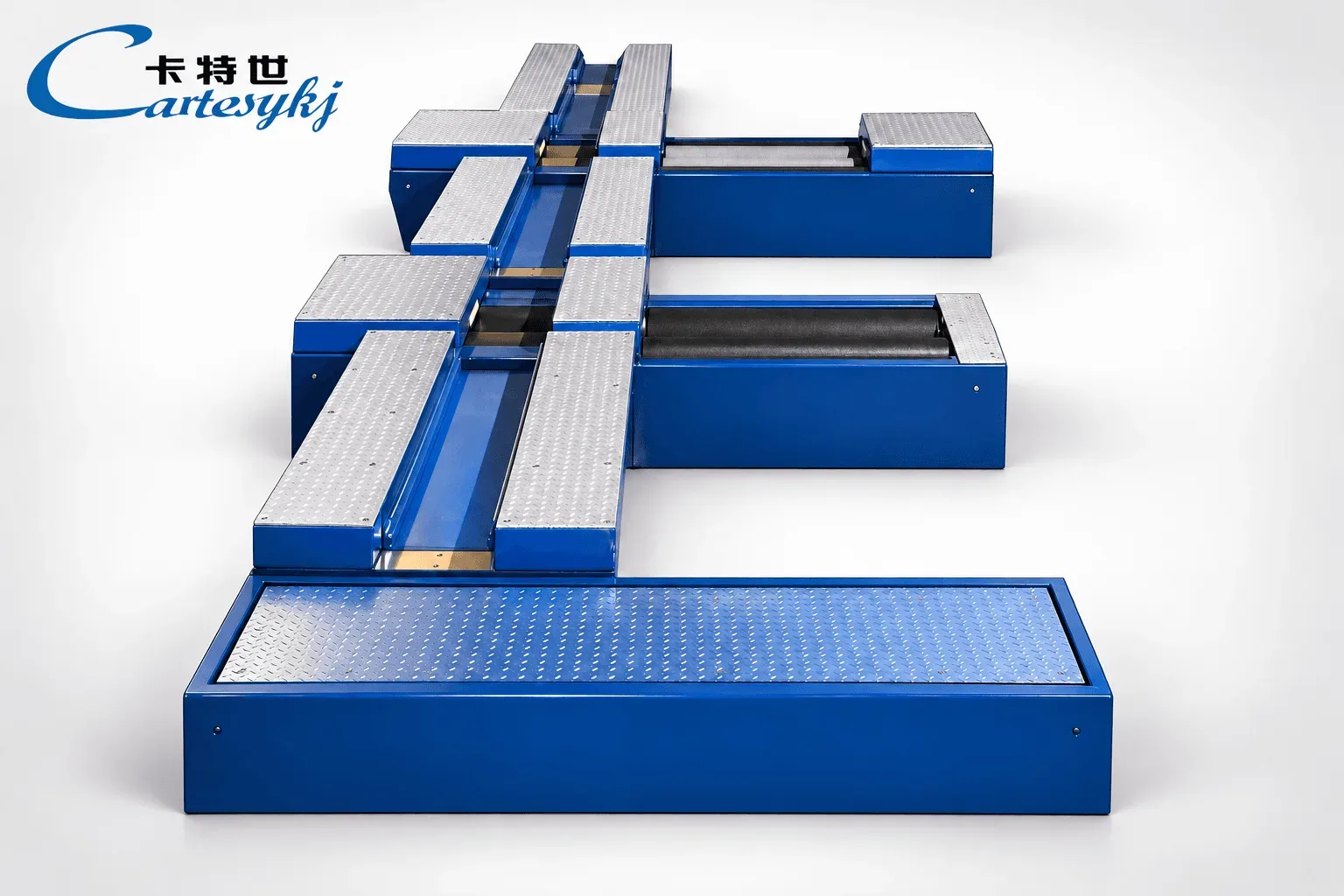
A Motorcycle(EV) Speedometer Tester is a specialized roller-based instrument designed to evaluate speedometer indication accuracy by running the driven or non-driven vehicle wheels on balanced rollers at pre-selected test speeds. In typical vehicle inspection station equipment layouts, the motorcycle speed measurement equipment is incorporated into multifunctional test platforms, such as the Cartesykj CTMT-750 and CT3JZMT-750 integrated test systems.
The testing scope accommodates several vehicle categories according to structural platform configuration:
- Two-wheel motorcycle speed testing: Standard commuter, high-capacity, and sport motorcycles requiring single-track alignment and controlled roller contact.
- Three-wheel motorcycle speed testing: Light freight and passenger trikes requiring widened roller track widths to support offset wheel paths safely.
- Electric motorcycle speedometer testing: Direct-drive and hub-motor electric two-wheelers and three-wheelers subjected to rapid torque variations during roller engagement.
- Motorcycle safety inspection system lines: Statutory roadworthiness inspection lanes operated by government-authorized testing stations, import verification depots, and technical service workshops.
It is vital to establish clear technical boundaries regarding equipment operation. The Cartesykj roller-based speedometer testing unit is an instrument for measuring and comparing displayed dashboard speed against true roller tangential speed. It is not an engine dynamometer or an inertial chassis dyno; it does not measure brake horsepower, engine torque output, mechanical losses, or acceleration curves. The Motorcycle(EV) Speedometer Tester roller system is engineered strictly for speed indication inspection within regulatory safety limits.
2. Buyer Value and Sourcing Considerations Supported by Supplied Facts
Setting up an efficient motorcycle inspection line requires an optimal balance between metrological precision, equipment durability, and lane throughput. Operating personnel face workflow bottlenecks when positioning vehicles, stabilizing wheel centers, or adjusting testing speeds manually. Sourcing decisions for a Motorcycle(EV) Speedometer Tester hinge on concrete mechanical parameters that minimize downtime and maintenance overhead.
Commercial motorcycle speedometer test bench installations provide key operational values across three primary areas:
- Throughput Efficiency via Pneumatic Lifting: A built-in pneumatic lifting plate supports the motorcycle during entry and exit. When raised, the pneumatic plate bridges the roller gap, preventing tire drop-in and reducing drive-in effort for testing personnel. Once lowered, the wheel sits firmly between the rollers for testing.
- Dynamic Speed Selection: Incorporating variable frequency speed control allows test operators to adjust roller drive speeds smoothly. Speed testing points can be selected without causing sudden mechanical shock to vehicle tires or roller bearings.
- Wireless Mobility: Operators execute speed point selection and test sequences via wireless remote control, allowing a single inspector to manage bike balance and throttle input without remaining tethered to a fixed console.
From an investment standpoint, procurement teams must evaluate whether standalone units or combined multifunction systems match their facility needs. While standalone test benches can address single-point testing, integrating the Motorcycle(EV) Speedometer Tester module with brake force testing and axle load measurement into unified platforms like the CTMT-750 or CT3JZMT-750 consolidates pit space, centralizes control wiring, and cuts civil installation costs.
3. Verified Technology Trends and Classifications
Motorcycle speed test bench systems have shifted from uncontrolled free-spin rollers to advanced variable frequency drive platforms. The Cartesykj motorcycle roller speed tester uses variable-frequency speed adjustment driven by an electric motor, maintaining predictable roller surface velocity across standardized speed points.
Working Principles of the Motorcycle Speedometer Tester
The motorcycle speedometer accuracy test follows a methodical sequence on the testing platform:
- The pneumatic lifting mechanism is elevated to create a flat transition surface over the roller pit.
- The motorcycle is driven onto the platform, centering the target wheel between the dynamically balanced rollers.
- The pneumatic lift lowers, seating the tire securely against the dual-roller assembly at a fixed 310 mm center distance.
- The drive motor, modulated by variable-frequency speed control, turns the rollers (or assists rotation according to the specific testing method), establishing controlled surface speeds up to 120 km/h.
- The inspector matches or reads the dashboard speedometer indication at specified intervals (e.g., 20 km/h, 40 km/h, 60 km/h) and checks it against the calibrated tester indication.
- The pneumatic lift raises once the cycle finishes, enabling the vehicle to roll smoothly off the bench into the next inspection station.
Integrated Motorcycle Inspection Systems
A Motorcycle(EV) Speedometer Tester frequently shares physical framing with complementary chassis testing hardware. The Cartesykj platform architecture combines several modular inspection tools:
- Motorcycle Speedometer Testing Function: High-precision roller assembly checking speedometer indication error within ±2%.
- Motorcycle Brake Force Tester: Dynamic roller-based brake assessment measuring wheel braking force and efficiency.
- Motorcycle Axle Load Tester: Integrated load cells capturing individual wheel and axle weights.
- Optional Wheel Deviation Testing: Specialized alignment sensors monitoring centerline tracking between front and rear wheels.
- Pneumatic Clamping Mechanism: Auxiliary fixtures stabilizing the non-tested wheel during single-wheel dynamic measurements.
4. Documented Specifications, Quality Controls, and Components
Engineering reliability depends on structural rigidity and dynamic component balancing. The Cartesykj motorcycle speedometer inspection platform features heavy-duty machined rollers, high-torque motor systems, and industrial pneumatics built to continuous-duty commercial specifications.
Technical Parameter
Documented Value / Specification
Operational Significance
Speedometer Testing Range
0–120 km/h
Accommodates mopeds, urban e-bikes, and highway-capable motorcycles.
Indication Error
±2%
Delivers metrological compliance for statutory roadworthiness checks.
Drive Motor Power
2.2 kW
Supplies stable mechanical torque across broad speed adjustments.
Roller Center Distance
310 mm
Maintains tire seating geometry and minimizes ride-out risk.
Available Roller Dimensions
2 × Ø176.6 × 300 mm / 2 × Ø176.6 × 1000 mm
Supports single-track 2-wheelers (300 mm) or wide 3-wheel platforms (1000 mm).
Lifting Mechanism
Pneumatic lifting system
Facilitates entry/exit and prevents tire entrapment between rollers.
Speed Adjustment Method
Variable-frequency speed control
Delivers smooth, stepless motor control without harsh speed jumps.
Control Interface
Wireless remote control
Enables single-operator control from the motorcycle seat.
Balancing & Acoustics
Dynamically balanced rollers
Suppresses operational vibration and ensures low-noise bench testing.
Dynamic balancing of the Ø176.6 mm steel rollers is crucial for structural longevity. Unbalanced rollers generate harmonic vibrations at peripheral speeds approaching 120 km/h, leading to premature bearing degradation and erratic speed readings. In any Motorcycle Speedometer Tester, precision dynamic balancing suppresses frame resonance, minimizes operational noise in enclosed inspection pits, and protects digital sensor feedback loops.
When specifying a Motorcycle Speedometer Tester, engineering teams should evaluate the roller surface diameter and center spacing relative to common tire profile dimensions. The documented 310 mm roller center distance provides stable geometric cradling, preventing tire slippage during variable-frequency acceleration cycles. Combined with a 2.2 kW drive motor, the assembly delivers reliable power for continuous testing operations.
5. Practical Sourcing and Risk-Mitigation Guidance
Sourcing commercial vehicle inspection equipment requires careful evaluation of technical requirements, civil work restrictions, and fleet demographics. Plant managers, lane contractors, and international distributors assessing a Motorcycle(EV) Speedometer Tester should apply this step-by-step framework when reviewing quotes and final specifications:
1. Define Vehicle Scope and Roller Dimensions
Verify whether testing operations target standard two-wheelers or expanded three-wheel fleets. The 2 × Ø176.6 × 300 mm roller set fits two-wheel motorcycle speed testing within standard lane widths. Facilities handling cargo trikes or passenger rickshaws require the 2 × Ø176.6 × 1000 mm roller configuration to accommodate wide wheel tracks. Confirming this configuration for your Motorcycle(EV) Speedometer Tester avoids costly foundation alterations later.
2. Verify Pneumatic and Electrical Infrastructure
Ensure your facility's utility supply matches equipment demands:
- Electrical Supply: Confirm three-phase power availability for the 2.2 kW variable-frequency drive motor, verifying local voltage and frequency stability.
- Compressed Air Capacity: Verify clean, dry pneumatic shop air to operate the pneumatic lifting plate and auxiliary wheel clamping mechanisms reliably.
3. Verify Calibration Protocols and Metrological Acceptance
Statutory test lanes require documented calibration pathways. Sourcing contracts for each Motorcycle(EV) Speedometer Tester should detail validation methods for the ±2% indication error threshold across the full 0–120 km/h operating band, ensuring equipment passes legal metrology commissioning tests before commercial handover.
A well-planned procurement process evaluates how the Motorcycle(EV) Speedometer Tester interfaces with other lane modules. By matching roller widths, pneumatic controls, and electrical ratings during planning, inspection operators can establish a high-throughput testing facility with minimal long-term operational friction.
Frequently Asked Questions
What is a motorcycle speedometer tester?
A Motorcycle(EV) Speedometer Tester is a roller-based testing system used to verify the accuracy of a motorcycle's speedometer by comparing its dashboard reading with the measured peripheral speed of calibrated rollers under controlled conditions.
How does motorcycle(EV) speedometer testing work?
The motorcycle wheel rests between two rollers set at a 310 mm center distance. Powered through variable-frequency speed control, the test bench operates across selected test points up to 120 km/h, allowing the operator to verify instrument accuracy against the bench readout.
What is the speed testing range and indication error?
The equipment features an operational speed testing range of 0–120 km/h with a tester indication error held within ±2%, fulfilling regular statutory vehicle inspection tolerances.
Can the equipment test electric motorcycles?
Yes. The platform supports electric motorcycle speedometer testing along with standard internal combustion two-wheelers and three-wheelers, provided the vehicle wheel dimensions match the roller layout.
What is the function of the pneumatic lifting system?
The pneumatic lifting mechanism raises a flat plate between the rollers to let motorcycles roll into and out of the test station easily. Lowering the lift locks the wheel into testing position between the rollers.
Can speedometer testing be integrated into a full motorcycle inspection line?
Yes. The speedometer testing unit can be deployed as part of modular inspection platforms, such as the Cartesykj CTMT-750 or CT3JZMT-750, which combine speedometer testing with brake testing, axle weighing, and wheel deviation checks.
Technical Consultation and Inquiries
Selecting the appropriate Motorcycle(EV) Speedometer Tester configuration depends on your test lane layout, daily vehicle throughput, and local inspection regulations. Cartesykj supplies robust testing equipment, comprehensive system schematics, and modular inspection platforms tailored to your testing lane requirements. Whether configuring a standalone roller module or an integrated CTMT-750 or CT3JZMT-750 line, choosing the right Motorcycle(EV) Speedometer Tester ensures compliance and operational reliability. Contact the Cartesykj engineering and sales team to discuss equipment dimensions, utility specifications, or integrated project layouts.
Related Products
Compare related inspection systems
Speedometer & Roller Auxiliary Equipment
Two-Wheel Motorcycle(EV) Speedometer Tester | CTJZMT-300B
View ProductRequest a Quote
Request configuration and pricing for your project.
Share your vehicle type, inspection lane layout, target capacity, and required model configuration for Motorcycle (EV) Speedometer Tester for Two & Three Wheels | CTMT-750 /CT3JZMT-750.
Share the project location, vehicle types, inspection scope, applicable standards, target throughput, site conditions and current stage. We will confirm the configuration scope before discussing pricing.