
Speedometer & Roller Auxiliary Equipment
Free Roller for Vehicle Inspection | CTZG
Testing multi-axle commercial transport vehicles on single-axle test benches introduces severe driveline binding and wheel slip risks. The Cartesykj CTZG Free Roller for Vehicle Inspection resolves these station constra...


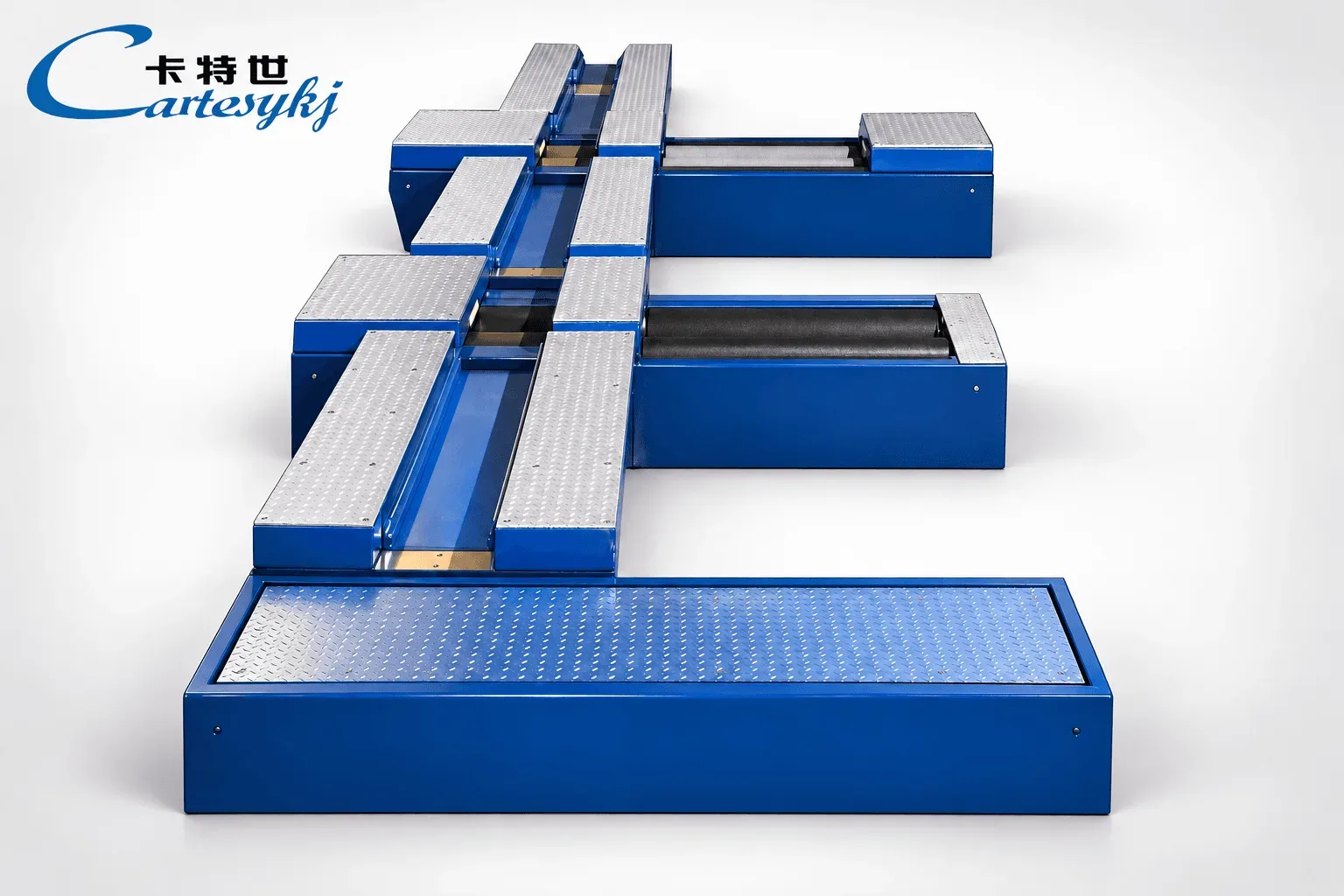
Testing multi-axle commercial transport vehicles on single-axle test benches introduces severe driveline binding and wheel slip risks. The Cartesykj CTZG Free Roller for Vehicle Inspection resolves these station constraints as specialized auxiliary equipment. Designed specifically to support inspection arrangements involving vehicles with two rear axles, this auxiliary free roller assembly stabilizes idle tandem wheelsets so adjacent driven axles can be evaluated accurately without mechanical interference.
Table of Contents
- Equipment Definition and Material/Application Scope
- Buyer Value and Sourcing Considerations Supported by Supplied Facts
- Verified Technology Trends and Classifications
- Documented Materials, Quality Controls, Certifications, and Components
- Practical Sourcing and Risk-Mitigation Guidance
- Frequently Asked Questions
- Quotation Inquiries and Technical Support
1. Verified Equipment Definition and Material/Application Scope
The Cartesykj CTZG Free Roller for Vehicle Inspection is an unpowered roller unit designed to support double rear axle vehicle inspection and tandem axle inspection equipment configurations. When a multi-axle vehicle enters a test bay, one rear axle rests on a dynamic measurement bench such as a roller brake tester or speedometer tester, while the neighboring axle rests directly on the auxiliary free roller.
As dedicated vehicle inspection roller equipment, the CTZG features two free-turning cylindrical rollers that allow idle vehicle wheels to spin freely. This unpowered design prevents suspension binding, chassis twist, and parasitic drive transfer during dynamic tests on adjacent vehicle testing equipment.
Documented application environments for this heavy vehicle inspection equipment include:
- Double rear axle vehicle inspection on high-throughput statutory testing lanes.
- Tandem rear axle vehicle inspection for commercial freight trucks and tractors.
- Vehicle inspection station equipment modernizations and foundation retrofits.
- Commercial vehicle inspection projects requiring vehicle inspection line accessories.
- Automotive inspection line installations where bay foundations match dual-axle spacing.
The CTZG functions strictly as an auxiliary roller within the vehicle inspection station equipment line. It is not an independent diagnostic bench and operates alongside certified measurement systems to ensure smooth vehicle handling.
Engineering Parameter
CTZG Equipment Specification
Equipment Designation
CTZG Free Roller for Vehicle Inspection
Equipment Classification
Auxiliary free roller equipment
Roller Geometry (Diameter × Length)
Ø190 mm × 1100 mm
Roller Center Distance
240 mm
Wheel Tread Accommodation (Inner / Outer)
700 mm / 2900 mm
Locking Mechanism
Pneumatic cylinder locking device
Electrical Power Supply
220V 50Hz
Structural Fabrication
Integrated welded steel supporting structure
2. Buyer Value and Sourcing Considerations Supported by Supplied Facts
Investing in an auxiliary free roller for vehicle inspection requires careful verification of axle spacing, tire track widths, and foundation depths. Implementing a tandem axle free roller in a heavy vehicle lane eliminates multi-axle driveline tension and preserves measurement stability on active benches.
Axle Geometry and Center Distance Verification
Commercial tandem axle bogies share equalizer beams that react instantly to vertical changes. The CTZG maintains a fixed roller center distance of 240 mm. This dimension forms a secure cradle for standard truck tires, ensuring steady seating without excessive wheel drop. Station buyers must confirm that target vehicle tire diameters fit this 240 mm roller center distance comfortably during testing.
Wheel Tread Range Evaluation
Fleet track widths vary widely between municipal vocational vehicles and full-width intermodal trailers. The CTZG provides an inner wheel tread of 700 mm and an outer wheel tread of 2900 mm across its 1100 mm roller barrels. Sourcing teams must ensure the transport fleet fits within this 700 mm to 2900 mm span to prevent sidewall scuffing or frame interference.
Technical Verification Aspect
CTZG Manufacturer Baseline
Buyer Sourcing Action
Fleet Wheel Tread Limits
700 mm inner / 2900 mm outer tread
Confirm fleet track measurements fall within the verified 700–2900 mm limits.
Cylindrical Contact Surface
1100 mm roller length
Verify that wide-base single tires or dual wheels seat fully on the roller barrel.
Cradle Center Distance
240 mm fixed center distance
Review vehicle entry angles and tire outer diameters against cradle depth.
Auxiliary Actuation
Pneumatic cylinder locking mechanism
Confirm regulated compressed air lines are routed to the foundation pit.
Operating Power
220V 50Hz single phase
Verify inspection line electrical distribution boards match 220V 50Hz ratings.
3. Verified Technology Trends and Classifications
In modern truck inspection equipment bays, procurement managers must distinguish between passive auxiliary units and active testing instruments. Operating a free roller for vehicle inspection serves a distinct mechanical role compared to active diagnostic machines.
Auxiliary Free Roller vs. Roller Brake Tester
An active roller brake tester incorporates electric gearmotors, transmission gearboxes, strain-gauge load cells, and slip sensors to measure dynamic braking force, wheel imbalance, and ovality. By contrast, the CTZG vehicle inspection auxiliary roller contains no electric motors, load cells, or deceleration sensors. It provides free-wheeling support so the non-tested driven axle does not drag or skew the axle undergoing active brake testing.
Auxiliary Free Roller vs. Speedometer Tester
A vehicle speedometer tester features precision rotational pulse encoders, inertia flywheels, or dynamic retarders to check vehicle speedometer calibration against actual surface speed. Although the CTZG features free-spinning cylinders, it lacks speed encoders, signal processors, and speed calibration software. It cannot be used as an independent speedometer tester.
Operational Characteristic
Active Roller Brake Tester
Active Speedometer Tester
CTZG Auxiliary Free Roller
Rotational Drive System
Electric motor driven
Driven by vehicle wheels
Passive; unpowered free rotation
Diagnostic Capabilities
Braking force, drag, imbalance
Speedometer error calibration
None; passive wheelset support
Measurement Transducers
Load cells, inductive sensors
Optical or digital encoders
None
Roller Locking Method
Drive-out motors or mechanical blocks
Mechanical or pneumatic plate lock
Integrated pneumatic cylinder device
Pneumatic Roller Locking System Function
A critical operational feature of the CTZG is its pneumatic roller locking system. While the vehicle is being tested, the locking device remains disengaged, allowing the cylinders to spin smoothly. Once the measurement cycle ends, the pneumatic cylinder engages the mechanical lock. Locking the free roller assembly provides the tires with solid traction, allowing the heavy truck to drive out of the roller pocket safely under its own power.
4. Documented Materials, Quality Controls, Certifications, and Components
A heavy duty roller assembly installed in high-volume testing facilities must withstand continuous axle transitions and abrasive debris. Cartesykj manufactures the CTZG free roller for vehicle inspection using controlled metallurgical and balancing procedures.
Dynamically Balanced Rollers
At high rotation rates during vehicle acceleration tests, out-of-balance rollers generate destructive vibrations that damage support bearings. The CTZG features dynamically balanced rollers. Dynamic balancing limits harmonic resonance, protects bearings from uneven cyclic loads, and promotes quiet, smooth rotation across varying vehicle speeds.
Wear Resistant Roller Surface Treatment
Commercial vehicle tires carry coarse sand, gravel, and road grit directly onto the test bed. The cylindrical roller surfaces of the CTZG undergo specialized surface treatment to enhance surface hardness and mechanical durability. This wear resistant roller surface protects against premature grooving, maintaining cylindrical concentricity over extended operational cycles.
High-Strength Welded Steel Frame Construction
The chassis of the CTZG uses quality steel sections assembled with stress-relieved welding techniques. Its integrated frame construction provides exceptional torsional stiffness, preventing structural distortion under heavy tandem wheelsets. The welded steel supporting structure ensures that the 240 mm roller center distance and parallel alignment remain uncompromised.
Verified sub-assemblies of the CTZG include:
- Dual free roller assembly (Ø190 mm × 1100 mm cylindrical rollers).
- Welded steel supporting structure with high-strength roller frame.
- Pneumatic cylinder locking mechanism.
- Electrical termination box wired for 220V 50Hz control supplies.
Exact internal bearing codes, fastener specifications, and sub-assembly positions should be verified against the manufacturer's technical drawings for each project layout.
5. Practical Sourcing and Risk-Mitigation Guidance
Integrating a free roller for vehicle inspection into an automotive inspection line requires coordinated planning across civil foundation construction, utility routing, and lane control architectures.
Civil Foundation Pit Requirements
The CTZG requires a concrete foundation pit constructed to Cartesykj certified drawings. Civil engineering teams must ensure flat mounting surfaces, adequate drainage, and conduit routing for electrical and pneumatic lines. Because tandem bogie wheelbases differ across heavy vehicle models, station designers must calculate the exact distance between the active brake tester pit and the auxiliary free roller pit.
Pneumatic and Electrical Supply Interfaces
Operating the CTZG requires verified utility supplies at the testing bay:
- Pneumatic Supply: Clean, dry compressed air must be supplied to actuate the pneumatic locking device reliably during drive-out sequences.
- Electrical Supply: The internal control circuits require an electrical power supply of 220V 50Hz. Stations with alternative line voltages must plan for power transformation before installation.
System Compatibility and Control Architecture
The CTZG operates as a purely mechanical and pneumatic unit without internal diagnostic microprocessors, speed sensors, or wireless data links. When integrating this tandem axle free roller into an automated commercial inspection line, pneumatic actuator control is typically coordinated through the central lane computer or dedicated manual operator consoles. Equipment compatibility must be reviewed against specific project configuration drawings.
Frequently Asked Questions
What is a free roller for vehicle inspection?
A free roller for vehicle inspection is an unpowered roller unit installed in an inspection bay to support non-tested wheels during multi-axle vehicle testing. It allows tires to rotate freely, preventing driveline bind and chassis skewing.
What is the CTZG Free Roller used for?
The Cartesykj CTZG is used as auxiliary equipment for double rear axle and tandem axle commercial vehicle inspections, providing stable, free-turning wheel support adjacent to active test benches.
Can the CTZG free roller for vehicle inspection measure brake force or speed?
No. The CTZG is an auxiliary unit without electric motors, load cells, or pulse encoders. It cannot independently measure braking force, vehicle speed, axle weight, or vehicle emissions.
What are the roller dimensions and center distance of the CTZG?
The CTZG features cylindrical rollers measuring 190 mm in diameter and 1100 mm in length (Ø190 × 1100 mm), with a fixed roller center distance of 240 mm.
Does the equipment include a pneumatic locking device?
Yes. The CTZG includes a pneumatic cylinder locking mechanism that locks the rollers at test completion, providing tires with sufficient traction to drive out smoothly.
What electrical power supply does the CTZG require?
The CTZG operates on a single-phase electrical supply of 220V 50Hz for its pneumatic control circuit.
Quotation Inquiries and Technical Support
Selecting the right free roller for vehicle inspection ensures safe, accurate testing of tandem rear axle commercial vehicles while protecting active test benches from parasitic driveline drag. Contact Cartesykj to request certified dimension drawings, verify multi-axle compatibility, and discuss foundation planning for your vehicle inspection station project.
Related Products
Compare related inspection systems
Speedometer & Roller Auxiliary Equipment
Motorcycle (EV) Speedometer Tester for Two & Three Wheels | CTMT-750 /CT3JZMT-750
View ProductSpeedometer & Roller Auxiliary Equipment
Two-Wheel Motorcycle(EV) Speedometer Tester | CTJZMT-300B
View ProductRequest a Quote
Request configuration and pricing for your project.
Share your vehicle type, inspection lane layout, target capacity, and required model configuration for Free Roller for Vehicle Inspection | CTZG.
Share the project location, vehicle types, inspection scope, applicable standards, target throughput, site conditions and current stage. We will confirm the configuration scope before discussing pricing.